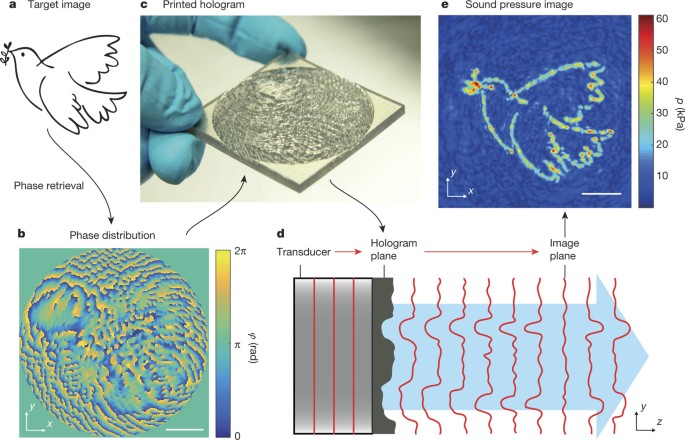
Melde, Mark, Qiu and Fischer's 2016 Nature paper does for ultrasound what a holographic plate does for light. The phase and amplitude information needed to produce a target sound field is baked into the thickness profile of a 3D-printed plate; put it in front of a single transducer and the field on the far side reproduces the pattern you designed.
Because the field carries acoustic radiation pressure, the pattern is not just visible, it is manipulative: the group used it to trap and move particles in liquid and air, contactlessly, without a phased array or any electronics beyond a driver.
For rig builders this is the cheap path to complex acoustic patterning. A printed plate has no channel count, no calibration and no cost per element; what it lacks is the ability to change its mind, since the field is fixed the moment you print it. Compare it with phased arrays before choosing.