Directory

176 people, projects, organisations, products, technologies and reference works around visible sound. A map of the field rather than a ranking: every entry links out to the thing itself.

People 34

Personborn 1951; activeÜberlingen, Germany

Alexander Lauterwasser

German photographer of sound-driven water surfaces

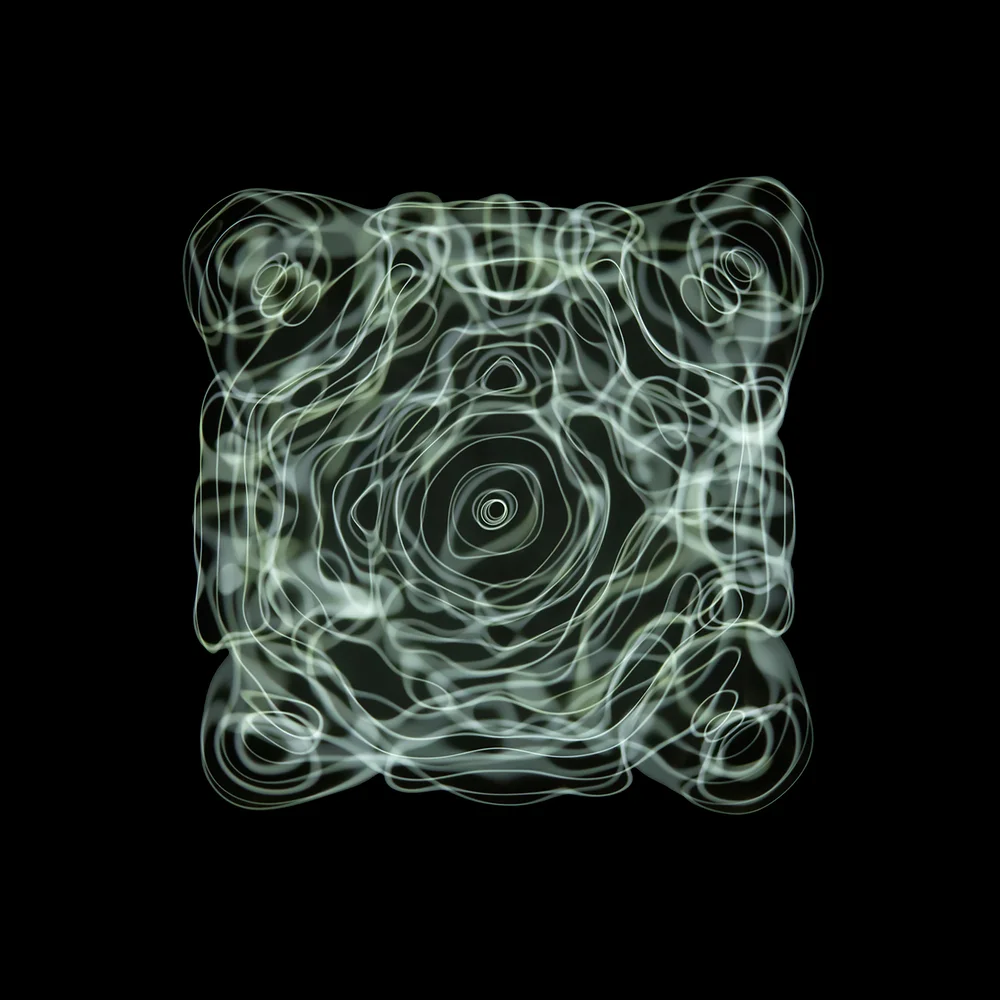
Lauterwasser was born in Überlingen in 1951. Working from Chladni's and Jenny's precedents, he photographs the surface of water excited by sound, from pure sine tones through recorded music to overtone chanting. His German book Wasser Klang Bilder appeared in 2002 and the English edition, Water Sound Images, was published by MACROmedia in 2006 with several hundred colour plates. His images are among the most widely reproduced in contemporary cymatics, though his framing mixes the physics with mystical interpretation and Wikipedia flags the article as needing better sourcing.

Image: Sein.de

Person1931–2021Middletown, Connecticut, United States

Alvin Lucier

Composer who made rooms, wires and beat frequencies audible as material
Lucier was born in Nashua, New Hampshire in 1931 and died in Middletown, Connecticut in 2021. He taught for decades at Wesleyan University and belonged to the Sonic Arts Union from 1966 to 1976. I Am Sitting in a Room, from 1969, re-records speech into a room until the room's own resonances swallow the words. Music On A Long Thin Wire, from 1977, drives a room-length piano wire with an oscillator and electromagnets, and Still and Moving Lines of Silence in Families of Hyperbolas, from 1973 to 1974, works with beat frequencies. Wikipedia's cymatics article lists him among artists who have used the field.

Image: Wikipedia — Alvin Lucier

Person1839–1894Germany

August Kundt

Used dust in a tube to show where sound stands still

Kundt was born in Schwerin in 1839 and died near Lübeck in 1894. In 1866 he built the apparatus now called Kundt's tube: finely divided powder, typically lycopodium, dusted inside a tube that is driven acoustically. The powder gathers in heaps at the nodes, so the spacing of the heaps gives the wavelength directly and lets the speed of sound be measured in different gases and solids. It is the airborne counterpart of a Chladni plate and one of the cheapest visible-sound demonstrations to build.
Image: Wikipedia — August Kundt

Personborn 1965; milch 2000Berlin and Chemnitz, Germany

Carsten Nicolai

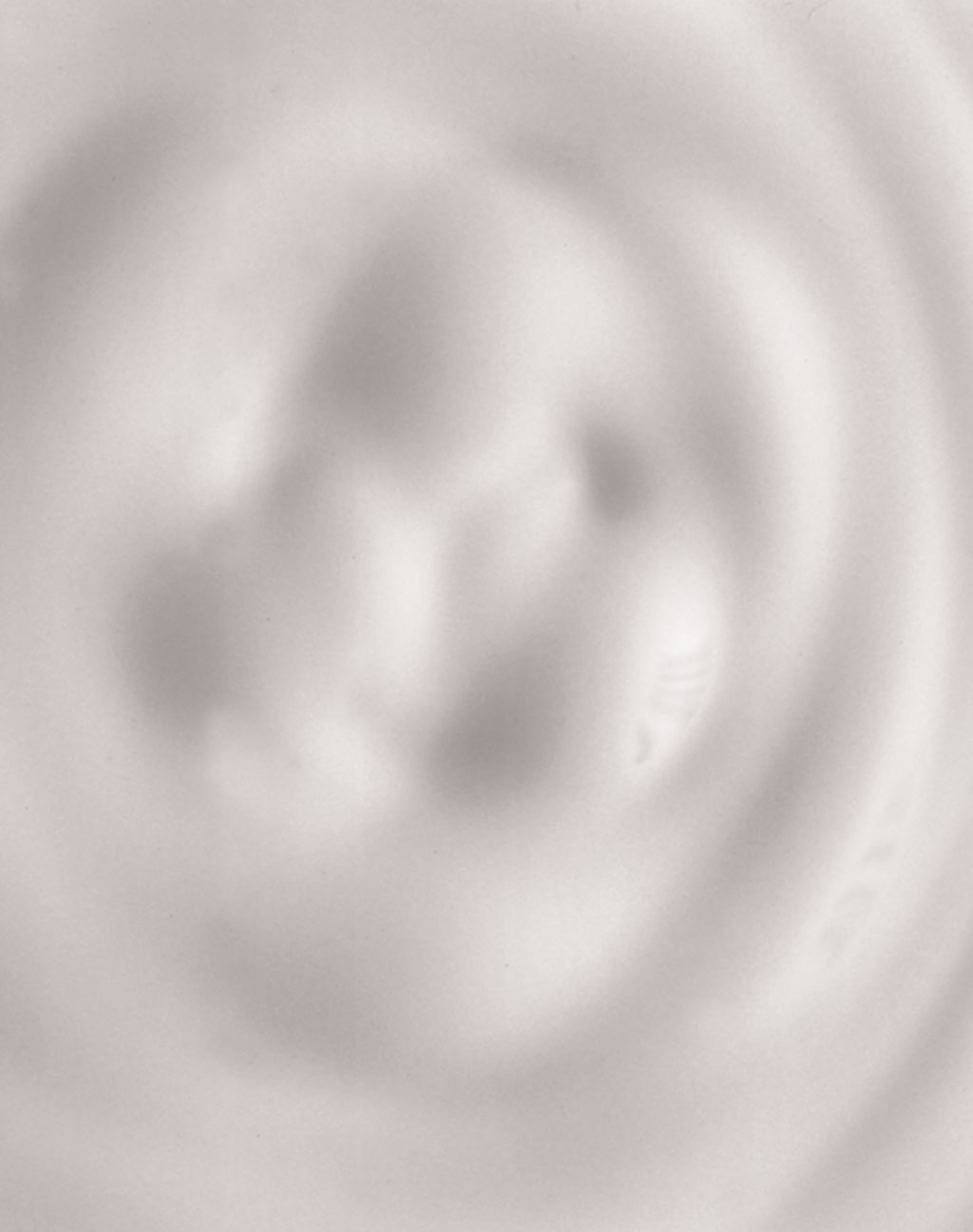
Artist and musician who photographed milk driven by sine tones

Nicolai was born in Karl-Marx-Stadt, now Chemnitz, in 1965, and records music as Alva Noto. His art practice is reductive and concerned with grids, codes, error and self-organisation. His work milch, dated 2000, is a series of ten lambda prints on aluminium, each 60 by 50 cm, made by exposing milk to sine tones from 10 to 150 Hz; the near-inaudible low frequencies set the liquid moving and each frequency yields a distinct pattern. He presents the result as showing the direct interrelation between acoustic signals and visual patterns.

Image: Dieter Wuschanski, Wikimedia Commons (CC BY-SA 4.0)

Person1802–1875London, England

Charles Wheatstone

Built the kaleidophone in 1827 to make vibration visible to the eye

Wheatstone was born near Gloucester in 1802 and died in Paris in 1875. In 1827 he introduced the kaleidophone, described as a device for rendering the vibrations of a sounding body apparent to the eye: a metal rod tipped with a silvered bead that reflected light and traced looping figures in the air as it vibrated. He had spent the 1820s experimenting with sound transmission through solids, exhibiting the Enchanted Lyre in 1821. The kaleidophone is an early ancestor of the harmonograph and of laser-on-mirror sound visualisation rigs.

Image: Wikipedia — Charles Wheatstone

Person1756–1827Wittenberg and Breslau (now Wrocław)

Ernst Chladni

German physicist whose sand-on-plate figures founded the field

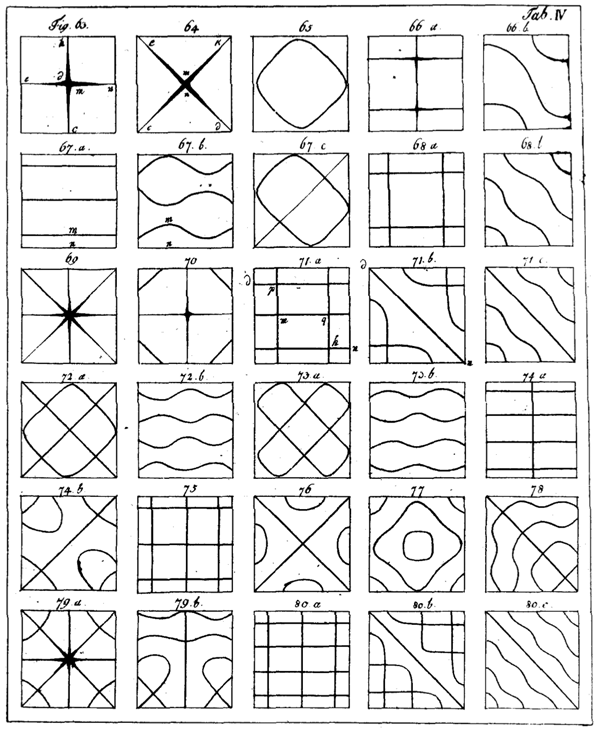
Chladni was born in Wittenberg in 1756 and died in Breslau in 1827. He drew a violin bow across the edge of a metal plate lightly covered with sand; at resonance the sand migrated away from the moving areas and gathered along the nodal lines, making the plate's vibrational modes visible. He published the technique in Entdeckungen über die Theorie des Klanges in 1787 and demonstrated it in Paris in 1808 before Napoleon, who then funded a prize for a mathematical explanation. He also argued that meteorites came from space, and invented two instruments, the euphon and the clavicylinder.

Image: Wikipedia — Ernst Chladni

Person2009; activeUnited Kingdom

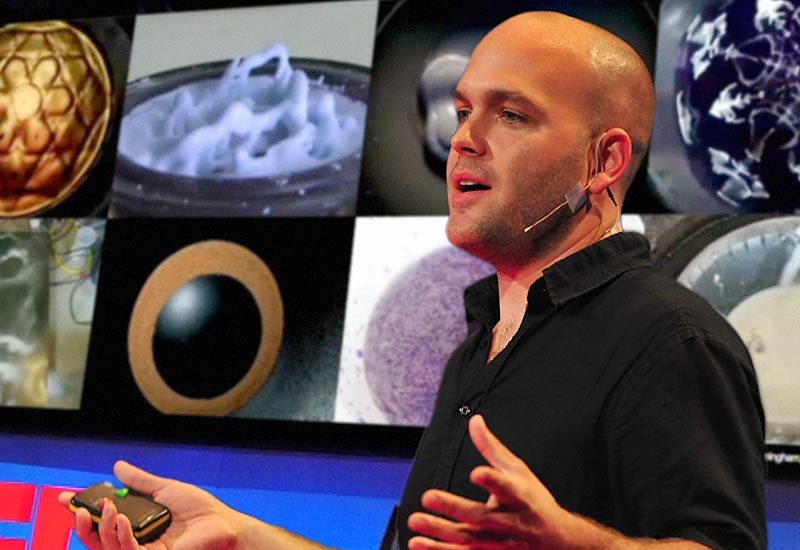
Evan Grant

Creative technologist who gave the TED talk on cymatics

Grant is a creative technologist and founder of seeper, an arts and technology collective established in 1998 that now describes itself as a builder of immersive experiences with offices in the UK and Saudi Arabia. At TEDGlobal in July 2009 he gave the talk "Making sound visible through cymatics", showing how sound waves can be made visible and applying the method to complex sounds such as dolphin calls. The talk has been played more than 1.2 million times and is, for many people, their first encounter with the subject.

Image: ted.com

Person1791–1841Paris, France

Félix Savart

French physician turned acoustician who studied vibrating bodies

Savart was born at Charleville-Mézières in 1791, took a medical degree at Strasbourg in 1816 and became a professor at the Collège de France in 1820, dying in Paris in 1841. His main interest was acoustics and the study of vibrating bodies: he built an experimental trapezoidal violin and devised the Savart wheel, a toothed rotating disc used to produce tones at known frequencies and to probe the limits of human hearing. He is best known outside acoustics for the Biot–Savart law, published with Jean-Baptiste Biot in 1820.

Image: Wikipedia — Félix Savart

Person1832–1901Marburg, Germany

Franz Melde

Coined the term standing wave and made the classic string demonstration

Melde was born near Fulda in 1832 and died in Marburg in 1901. He joined the Mathematical and Physical Institute at the University of Marburg as an assistant in 1860 and succeeded Christian Ludwig Gerling as professor in 1864. Around 1860 he coined the German term stehende Welle, standing wave, and devised the experiment that still bears his name: a driven string that shows visible loops and nodes, allowing transverse wave speed and the effects of tension, length and mass to be measured. It is the simplest classroom precursor to plate and membrane cymatics.

Person1923–2012Manchester, England

Fritz Ursell

Mathematician who co-wrote the 1954 Faraday wave stability paper

Fritz Joseph Ursell was born in Düsseldorf in 1923, came to England as a Jewish refugee in 1937, and died in Manchester in 2012. He studied at Trinity College, Cambridge, worked on wave forecasting during the Second World War, and held the Beyer Chair of Applied Mathematics at the University of Manchester from 1961 to 1990. He is best known within cymatics as co-author, with Thomas Brooke Benjamin, of the 1954 analysis of the stability of a flat liquid surface under vertical periodic motion, the standard theoretical account of the Faraday instability.

Image: Wikipedia — Fritz Ursell

Person1564–1642Pisa and Florence, Italy

Galileo Galilei

Named among the earliest observers of patterns on vibrating surfaces

Galileo was born in Pisa in 1564 and died at Arcetri in 1642. Wikipedia's article on cymatics places him at the start of the field, crediting him with early experiments on vibrating surfaces around 1630, shortly before the publication of his Discorsi e Dimostrazioni Matematiche, intorno a due nuove scienze in 1638. The detail available is thin and his biography does not describe the experiment, so treat him as a footnote to the prehistory of cymatics rather than a founder of it.

Image: Wikipedia — Galileo Galilei

Person1824–1887Berlin, Germany

Gustav Kirchhoff

Fixed the boundary conditions that make free-edged plates solvable

Kirchhoff was born in Königsberg in 1824 and died in Berlin in 1887. In an 1850 paper he resolved a long-standing inconsistency in plate theory, where the governing differential equation admitted two boundary conditions per edge but naive derivations produced three. Using the calculus of variations on the strain energy, he showed that twisting moments along an edge can be replaced by equivalent transverse forces. The result, now called Kirchhoff–Love plate theory, is what allows the free-edge conditions of a real Chladni plate to be modelled and its mode shapes predicted.

Image: Wikipedia — Gustav Kirchhoff

Person1904–1972Basel and Dornach, Switzerland

Hans Jenny

Swiss physician who coined the word cymatics and built the tonoscope

Jenny was born in Basel in 1904 and died at Dornach in 1972. A physician and natural scientist, he taught at the Rudolf Steiner School in Zürich before entering medical practice, and he coined the term cymatics for the visible effects of sound on matter. He used crystal oscillators to drive plates and membranes, famously spreading quartz sand on a 60 cm drum membrane and singing into it, and he invented the tonoscope. His two volumes of Kymatik appeared in 1967 and 1972. He was an anthroposophist, and his interpretations sometimes go well beyond what the physics supports.

Image: MACROmedia Publishing, cymaticsource.com

Personborn 1939; active from 1970sAustin, Texas, United States

Harry Swinney

Physicist who found oscillons in vertically shaken granular layers

Swinney was born in Louisiana in 1939 and joined the University of Texas at Austin in 1978, where he became Sid W. Richardson Foundation Regents Chair of Physics and directed the Center for Nonlinear Dynamics. His group works on pattern formation in driven systems, and in 1996 Umbanhowar, Melo and Swinney reported localised structures they named oscillons in an oscillating granular layer, a discovery later echoed in many other systems. Earlier work with Melo and Umbanhowar in 1995 mapped the extended patterns, shocks and fluctuations that appear on a vibrated layer of grains, the dry-media cousin of Faraday waves.

Image: Wikipedia — Harry Swinney

Person1865–1922Berlin, Germany

Heinrich Rubens

Built the flame tube that draws standing sound waves in fire

Rubens was born in Wiesbaden in 1865 and died in Berlin in 1922. In 1905 he built what is now called the Rubens' tube, a length of pipe perforated along its top and filled with a flammable gas, with a speaker at one end. At a resonant frequency the flame heights follow the standing pressure wave inside the tube, drawing it in fire. It is a staple of sound-visualisation demonstrations and appears in Nigel Stanford's Cymatics video, though it is also genuinely dangerous to build.

Image: Wikipedia — Heinrich Rubens

Person1821–1894Berlin, Germany

Hermann von Helmholtz

Analysed complex sound into its components with tuned resonators

Helmholtz was born in Potsdam in 1821 and died in Charlottenburg in 1894. His 1863 book On the Sensations of Tone connected the physics of vibration to musical perception and influenced musicology well into the twentieth century. He invented the Helmholtz resonator, a tuned cavity that responds to one frequency and so isolates the sine components of a complex sound. That idea, sound as a spectrum of separable components rather than an undifferentiated noise, is what makes it meaningful to speak of the pattern belonging to a particular frequency.

Image: Wikipedia — Hermann von Helmholtz

PersonactiveEliot, Maine, United States

Jeff Volk

Publisher who keeps Hans Jenny's cymatics books in print

Volk runs MACROmedia Publishing from Eliot, Maine, and operates CymaticSource, a site devoted to cymatics literature, films and events. MACROmedia publishes the combined revised edition of both of Hans Jenny's original Kymatik volumes as an oversize clothbound hardcover, along with a biographical portrait of Jenny, and issued the English edition of Alexander Lauterwasser's Water Sound Images. He is the main reason Jenny's work is still readable in English rather than only in scarce Swiss editions, and he also organises conferences on the subject.

Image: CymaticSource / MACROmedia Publishing (Jeff Volk's own site)

Person1944–2019Haverford, Pennsylvania, United States

Jerry Gollub

Experimental physicist of fluid pattern formation and transition to chaos

Jerry Gollub was born in St Louis in 1944 and died in Haverford, Pennsylvania in 2019. He was a physics professor at Haverford College from 1971 to 2012, was elected a Fellow of the American Physical Society in 1983 for research on Rayleigh–Bénard convection and the transition to turbulence, and became a member of the National Academy of Sciences in 1993. He published with Harry Swinney on the onset of chaos in rotating fluids in 1975. His field, the emergence of ordered spatial patterns in driven fluids, is the physics that underlies vibrated-liquid cymatics.

Image: Wikipedia — Jerry Gollub

PersonactiveUnited Kingdom

John Stuart Reid

British acoustics researcher behind the CymaScope instrument

Reid describes himself as an acoustic-physics scientist with a career in acoustics spanning five decades, and founded Sonic Age Ltd in the United Kingdom and Sonic Age America. He invented the CymaScope Pro, which the site calls the world's first commercial instrument that renders sound visible in water, and which is presented as giving an analogue image of a sound rather than a computed one. He lectures at conferences in Europe and America. The site also publishes material on sound therapy and music medicine; those therapeutic claims are contested and should not be read as established science.

Image: cymascope.com

Person1653–1716Paris, France

Joseph Sauveur

French acoustician who named the subject and identified nodes on strings

Sauveur was born at La Flèche in 1653 and died in Paris in 1716. He coined the term acoustique, from the Greek for "able to be heard", and studied the relationship between frequency and musical pitch, harmonics, tuning and vocal range. He began acoustics research around 1694 with the musician Étienne Loulié and presented his main findings to the French Academy of Sciences in 1701. His identification of the nodes of vibrating strings is the direct conceptual ancestor of the nodal lines that sand traces on a Chladni plate.

Image: Wikimedia Commons (public domain)

Person1822–1880France

Jules Antoine Lissajous

Turned tuning-fork vibration into projected light figures

Lissajous was born at Versailles in 1822 and died at Plombières-les-Dijon in 1880. His 1850 thesis was titled Sur la position des noeuds dans les lames qui vibrent transversalement, on the position of nodes in transversely vibrating plates, placing him squarely in the Chladni tradition. He is remembered for the apparatus that bounces a light beam off mirrors mounted on two perpendicular tuning forks, projecting the curves now called Lissajous figures. The method led on to the harmonograph and remains the basis of laser-scanning sound visualisation.

Image: Wikipedia — Jules Antoine Lissajous

PersonactiveUnited States

Linden Gledhill

Photographer who shoots cymatics, ferrofluid and paint driven by sound

Gledhill is a photographer and artist working with macro and high-speed techniques, microscopy and crystallisation, drawing on a background in science. His site carries a dedicated Cymatics gallery; he used glass particles on Chladni plates for a 2016 GMC Sierra Denali advertisement, photographed paint ejected from a loudspeaker surface for Rome Snowboards and BT Vision idents, and made the Fe2O3 Glyphs ferrofluid series with Craig Ward. He co-invented StackShot, an automated macro focusing rail, with Cognisys, and has worked with musicians including Jon Hopkins and Ryan Teague.

Image: Linden Gledhill, from the Cymatics gallery on lindengledhill.com

Person1842–1919Essex and Cambridge, England

Lord Rayleigh (John William Strutt)

Author of The Theory of Sound and early analyst of vibrating liquid surfaces

John William Strutt, third Baron Rayleigh, was born in Maldon in 1842 and died in Witham in 1919. He was Cavendish Professor of Physics at Cambridge from 1879 to 1884, Professor of Natural Philosophy at the Royal Institution from 1887 to 1905, and won the 1904 Nobel Prize in Physics for his work on gas densities and the discovery of argon. His two-volume The Theory of Sound, published in 1877 and 1878, remains a standard reference. In 1883 he published "On the crispations of fluid resting upon a vibrating support", an early treatment of Faraday waves.

Image: Wikipedia — John William Strutt, 3rd Baron Rayleigh

Person1943–2014Japan

Masaru Emoto

Made discredited claims that words and music reshape water crystals

Emoto was born in Yokohama in 1943 and died in 2014. He claimed that human consciousness alters the molecular structure of water, so that water exposed to kind words or music freezes into attractive crystals while negative intent produces distorted ones, and that polluted water can be cleaned by prayer. His 2004 book The Hidden Messages in Water was a bestseller. Wikipedia describes him as a pseudoscientist; critics identified absent controls and experiments open to manipulation, and biochemist William Reville wrote that "it is very unlikely that there is any reality behind Emoto's claims". He never took up James Randi's 2003 million-dollar challenge.

Image: Wikipedia — Masaru Emoto

PersonactiveSan Francisco Bay Area, United States

Meara O'Reilly

Composer who sings Chladni patterns into existence

O'Reilly is a composer and sound artist who builds instruments and researches resonance, illusion and alternative notation. Her instrument projects include Chladni Singing, in which the voice rather than an oscillator drives the plate, alongside Glass Bells, Rhythm Necklace and a Beat Frequency Interface. She has worked with the Exploratorium, SFMOMA, BAM and Brightworks, institutions clustered around the San Francisco Bay Area. Her composition Hockets for Two Voices is out on Cantaloupe Music, with live performances scheduled for 2026. Her work is a rare case of cymatics used as a musical instrument rather than as illustration.

Image: Meara O'Reilly (mearaoreilly.com)

Person1842–1907Wales and London

Megan Watts Hughes

Welsh singer who invented the eidophone and photographed voice figures

Also known as Margaret Watts Hughes, she was born at Dowlais in Glamorgan in 1842 and died in 1907. In 1885, while exercising her voice, she noticed that singing into a device of her own making produced patterns in powder and liquid on a stretched membrane. She described the eidophone as "an elastic membrane, such as thoroughly flexible soft sheet-rubber, tightly stretched over the mouth of a receiver". She published "Visible Sound" in The Century Magazine in 1891 and the book The Eidophone Voice Figures in 1904.

Image: Wikipedia — Megan Watts Hughes

Person1791–1867London, England

Michael Faraday

Discovered the standing wave patterns that form on vibrated liquids

Faraday, born in 1791 and best known for electromagnetic induction and electrolysis, worked at the Royal Institution in London from 1821 until his death in 1867. In 1831 he published an appendix to a paper titled "On the forms and states assumed by fluids in contact with vibrating elastic surfaces" in the Philosophical Transactions of the Royal Society. It described the ordered ripples that appear on a liquid layer when its container is shaken vertically. These are now called Faraday waves, and they underlie almost every water and thin-film cymatics rig.

Image: Wikipedia — Michael Faraday

Person2013–2014; activeNew Zealand and United States

Nigel Stanford

Musician whose Cymatics video put the subject in front of millions

Stanford is a music producer whose video Cymatics, from the album Solar Echoes, was shot in December 2013 and carries a 2014 copyright. Unusually the music was composed after the footage was filmed rather than before. The video runs through a sequence of visible-sound experiments: a Chladni plate, a speaker dish of liquid, a hose pipe filmed at a matched frame rate, ferrofluid, a Rubens' tube and a Tesla coil. YouTube's oEmbed data lists the video as "CYMATICS: Science Vs. Music - Nigel Stanford" on the channel Nigel John Stanford.

Image: Nigel Stanford, Cymatics

Person1635–1703London, England

Robert Hooke

Made nodal patterns visible on a floured glass plate in 1680

Hooke was born on the Isle of Wight in 1635 and died in London in 1703. On 8 July 1680 he ran a bow along the edge of a glass plate covered with flour and watched nodal patterns appear on its surface. This predates Chladni's systematic work by more than a century and is usually cited as the first recorded observation of what would later be called a Chladni figure. Hooke did not develop the technique into a method, so the patterns carry Chladni's name rather than his.

Image: Wikipedia — Robert Hooke

Person1832–1901Paris, France

Rudolph Koenig

Instrument maker whose manometric flames made sound visible in 1862

Koenig was born in Königsberg in 1832 and died in Paris in 1901. After a seven-year apprenticeship with the violin maker Jean-Baptiste Vuillaume he opened his own Paris workshop in 1858, building tuning forks, resonators, sound analysers and wave machines largely by hand. In 1862 he developed the manometric flame apparatus, in which sound pressure modulates a gas flame whose image is stretched out by a rotating mirror, and exhibited it in London that year. It is one of the first devices to give a continuous visual trace of a sound waveform.

Image: Wikipedia — Rudolph Koenig

Person1776–1831Paris, France

Sophie Germain

Won the Paris prize for the first mathematics of vibrating plates

Germain was born in Paris in 1776 and died there in 1831. The Paris Academy of Sciences ran a prize competition for a mathematical theory of vibrating elastic surfaces that would account for Chladni's plate experiments. She entered in 1811 and again in 1813, receiving an honourable mention, and won on 8 January 1816 with Recherches sur la théorie des surfaces élastiques, becoming the first woman to win a prize from the Academy. Her equation was not fully rigorous and the Academy remained unsatisfied, but the work began the theory that later predicts Chladni figures.

Image: Wikipedia — Sophie Germain

PersonactiveGermany

Sven Meyer

Credited for idea and sound on Kymat's cymatics installations

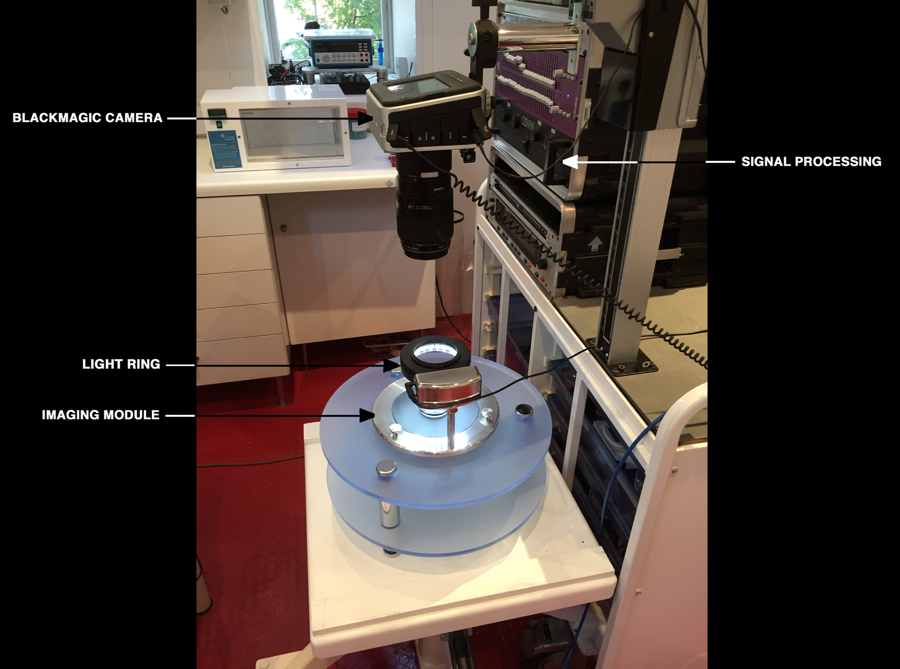
Meyer is credited on the German cymatics art project Kymat's site for idea and sound on its Art Basel installation. Kymat describes itself as an art project combining art, biophonics and wave physics: a bowl of water sits on a loudspeaker membrane, each tone transfers directly to the water surface, and a high-speed camera above with ring lighting captures the resulting patterns. The project produces installations, live audiovisual performances, two albums and fine-art prints. Its framing that the patterns reflect universal ordering principles in nature is interpretation, not a result of the physics.

Image: Kymat (kymat.de)

Person1929–1995Cambridge and Oxford, England

Thomas Brooke Benjamin

Co-author of the 1954 stability analysis behind Faraday waves

Benjamin was born in 1929 and died in 1995. He was a fellow at Cambridge from 1955 to 1964 and Sedleian Professor of Natural Philosophy at Oxford from 1979 until his death, elected a Fellow of the Royal Society in 1966. His work centred on nonlinear differential equations applied to fluid mechanics, including internal waves and long surface gravity waves. With Fritz Ursell he published "The stability of the plane free surface of a liquid in vertical periodic motion" in 1954, the paper that put Faraday's observation on a firm theoretical footing.

Image: Wikipedia — Brooke Benjamin

Person1941–2019Paris, France

Yves Couder

Made droplets walk on a Faraday-vibrated bath

Couder was born at Boulogne-Billancourt in 1941 and died in Paris in 2019. He was a professor at University Paris-Diderot from 1985 and was elected to the French Academy of Sciences in 2013, working on two-dimensional turbulence in soap films, hydrodynamic instabilities and plant morphogenesis. From 2005 his laboratory was the first to study bouncing droplets systematically: a droplet held just below the Faraday instability threshold on a vertically shaken bath rides its own wave field. With Emmanuel Fort he showed in 2006 that such walkers passing through slits produce interference-like statistics.

Image: © B. Eymann, from the Yves Couder memorial meeting site (Université Paris Cité)

Projects 27

Project2024MIT, Cambridge, USA

3DChladni

Web tool for rendering Chladni patterns as three-dimensional surfaces

An experimental web application for rendering and exploring 3D Chladni patterns, built during the sixth week of MIT's Summer Geometry Initiative in 2024 by fellows Nicolas Pigadas, Sachin Arvind Kishan and Bethlehem Tassew, mentored by Martin Skrodzki. It uses a Django backend with a Three.js front end and marching cubes for implicit surfaces, and follows the 2016 paper "Chladni Figures Revisited: A Peek Into The Third Dimension" by Skrodzki, Reitebuch and Polthier. Useful if you want to know what a plate mode looks like as a volume rather than a picture.

Image: 3DChladni (SGI 2024 fellows: N. Pigadas, S. A. Kishan, B. Tassew), CDInstitute/3DChladni README

Project2017Open source, online

Chladni figures interactive (dmackinnon1)

Browser tool for superimposing plate modes, including impossible ones

A small HTML and JavaScript page and script for generating Chladni figures, with a live demo. Controls let you change frequency, switch between fixed-edge and freely vibrating edge conditions, and delete individual vibrations, so you can stack modes that could not physically coexist on one plate. The repository has 11 stars and was last updated in July 2017. It is the quickest way to sanity-check what a given mode combination should look like before cutting metal.

Image: github.com

Projectactive (updated 2026)Open source, online

Chladni figures simulation (ratwolfzero)

Python and PyQt simulation with a sand view and resonance curves

A Python project that models the resonant modes of a square membrane by superposing eigenmodes weighted by how close the driving frequency sits to each natural resonance, rather than simulating particle motion directly. It ships a plain script and a PyQt version with a GUI, offers magnitude, phase and sand views, and lets you vary driving frequency and damping while showing the resonance curve. The README is candid that it captures the visual essence without the full elastic-bending physics.

Image: github.com

Project2023Europe

Chladni plate elastic constants method

Using Chladni patterns to measure wood non-destructively

A method by Michele Ducceschi, Sebastian Duran, Henna Tahvanainen and Ludovico Ausiello, posted to arXiv in November 2023, for estimating the elastic constants of rectangular orthotropic plates from measured frequencies and identified mode shapes using least squares. It works regardless of how the plate is clamped and uses linear mathematics, so it is computationally cheap. This is the modern, quantitative descendant of the old luthier's trick of bowing a violin plate and reading the sand: the same patterns, used as measurement rather than decoration.

Image: Ducceschi, Duran, Tahvanainen & Ausiello, arXiv:2311.06935

ProjectactiveOpen source, online

Chladni plate simulation (luciopaiva)

Drawing Chladni figures from a closed-form standing-wave formula.

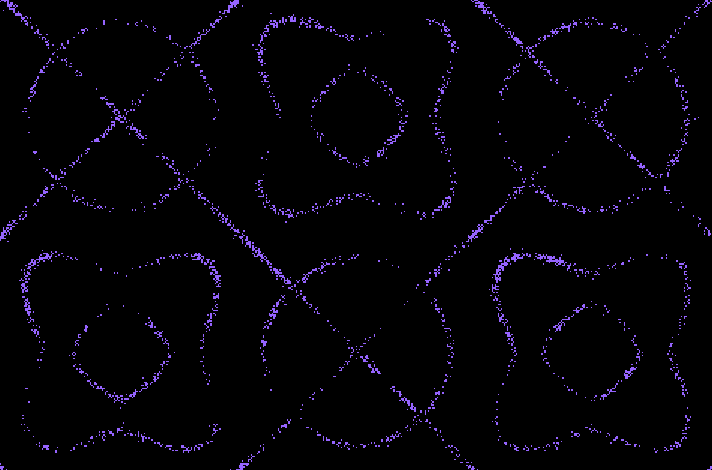
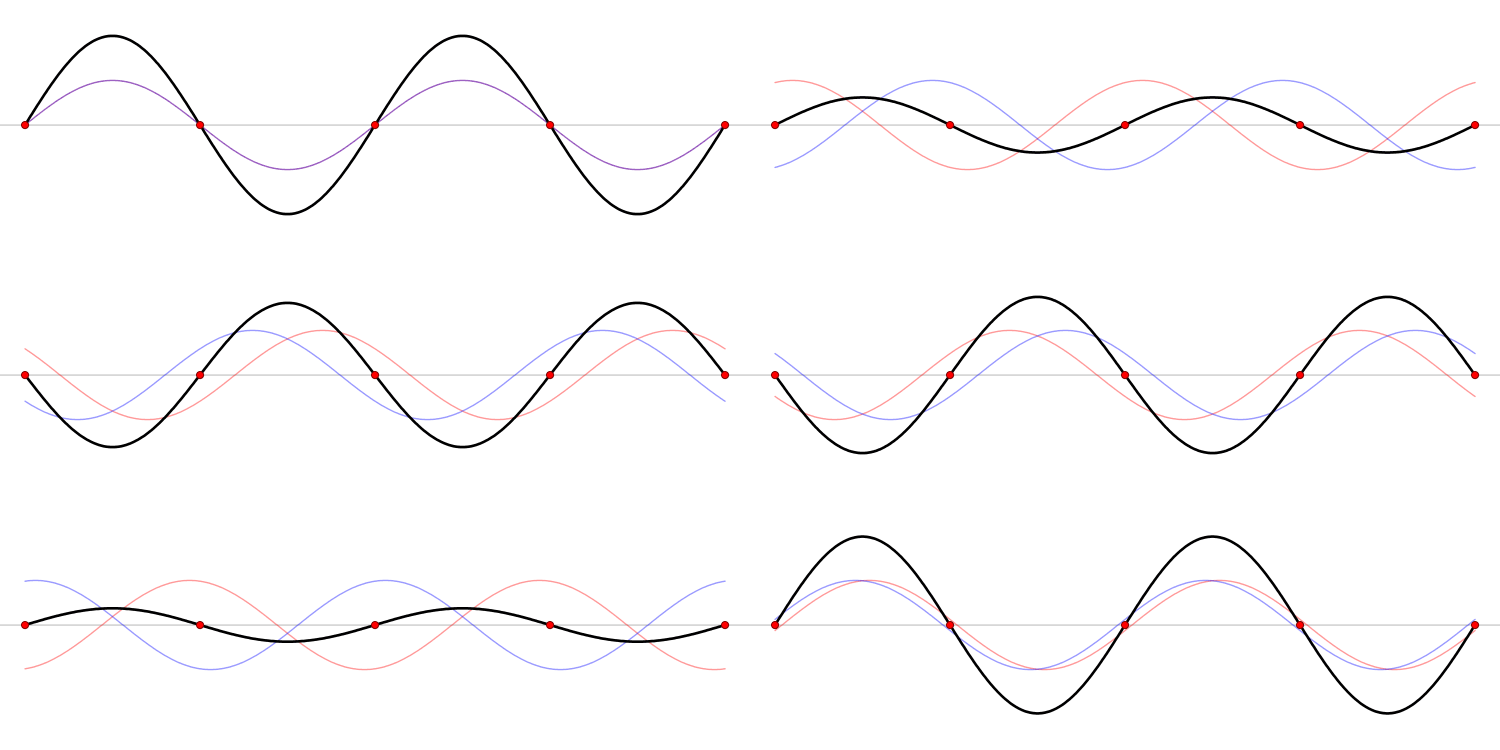
For a square plate of side L the nodal lines of a mode pair (m, n) are approximated by the zeros of cos(nπx/L)cos(mπy/L) − cos(mπx/L)cos(nπy/L); Paul Bourke's 2001–2003 notes give this and the Bessel version for circular plates. Lucio Paiva's open-source vanilla-JavaScript simulation scatters particles that random-walk toward those zeros, mimicking sand. Such simulations are approximations for idealised boundaries, not finite-element solutions, but they are enough to preview patterns, generate graphics and drive lighting rigs from a chosen mode.

Image: Lucio Paiva, luciopaiva/chladni repository screenshot

ProjectactiveFrance

Chladni simulator (femto-physique)

French educational p5.js simulator of vibrating plates

A hosted Chladni figures simulator on the French physics teaching site femto-physique.fr, built as a p5.js sketch with controls for frequency and plate type. The page cites published work on reconstructing Chladni patterns and determining resonant wave numbers, and links a GitHub fork of the sketch by JimRou. It is the most classroom-ready of the open simulators, and a useful cross-check because it is grounded in cited plate theory rather than a decorative approximation.

Image: femto-physique.fr

Project2013–presentSan Francisco, USA

Chladni Singing

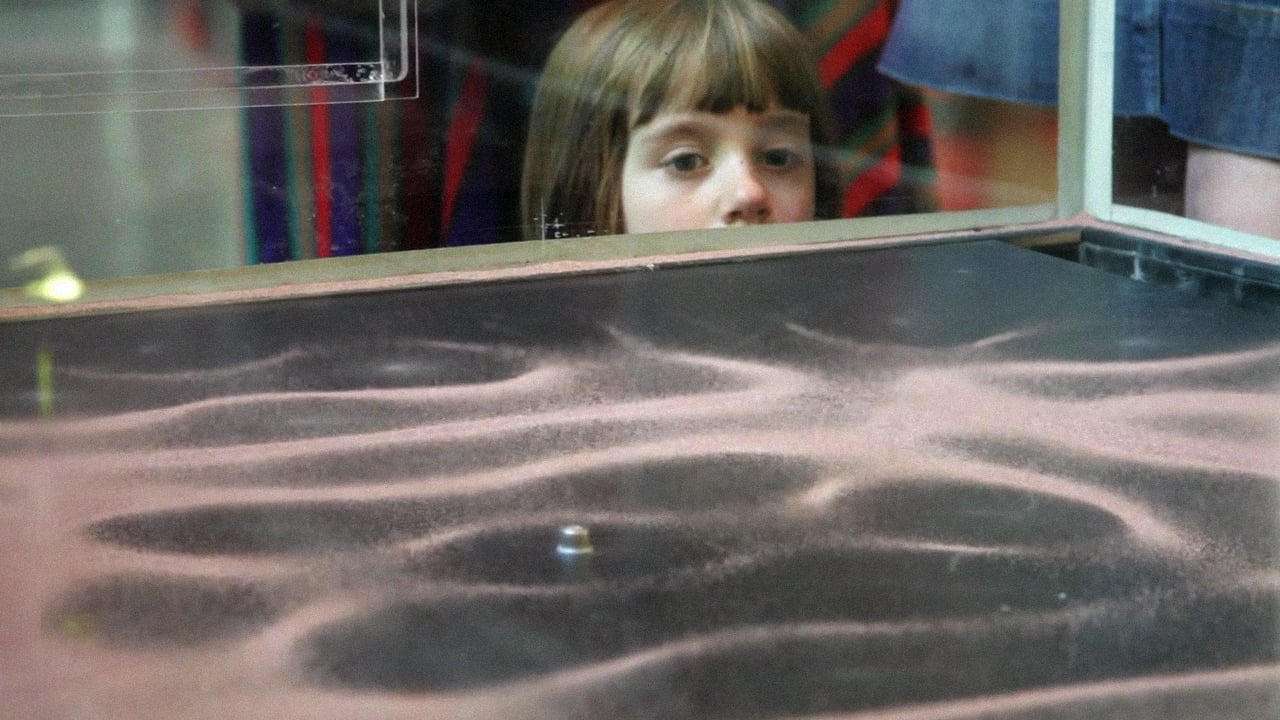
Exploratorium exhibit where your own voice makes the sand move

A permanent exhibit developed and built by the composer and sound artist Meara O'Reilly in collaboration with the Exploratorium's Central Gallery, installed in 2013. Visitors sing into the exhibit and a Brüel & Kjær V408 vibration driver transmits the voice into a plate, so patterns appear without a signal generator in the loop. O'Reilly's account stresses that finding the modes by voice turned out to be intuitive rather than fiddly, which is the design lesson for anyone building a public-facing plate.

Image: Encyclopedia Pictura / Meara O'Reilly, 'Chladni Singing - Exhibit Prototype' (Vimeo)

Project2026China

ChladniSonify

Real-time mapping from Chladni patterns back into sound

A research prototype described in an arXiv paper by Yakun Liu, Hai Luan, Dong Liu and Zhiyu Jin, submitted in May 2026, that reverses the usual direction of cymatics by recognising Chladni pattern variations with a deep learning model and mapping them to frequencies. The authors report 99.33 per cent accuracy on their test set with 7.03 ms inference latency and average end-to-end latency under 50 ms, and present it as a reproducible engineering prototype for audio-visual art creation.

Image: Liu, Luan, Jin & Liu, arXiv:2605.09846

Project2018London, United Kingdom

Cymatics Live (Reeps One)

Large-scale cymatic visualisers built for live vocal performance

A 2018 performance work by the London artist Harry Yeff, who performs as Reeps One, using vibration to organise matter as a visualisation medium for vocal music. His site credits the concept to Yeff with Zach Walker and Linden Jay, and development to Ben Hopper, and states that the cymatics photography series and live performances received a Prix Ars Electronica nomination in 2016. It sits alongside his related works Vocal Vibration in Water (2018) and Organic Electronic Vibration Structure (2019).

Image: reeps100.com

ProjectactiveOnline

Cymatics Visualizer (SYQEL)

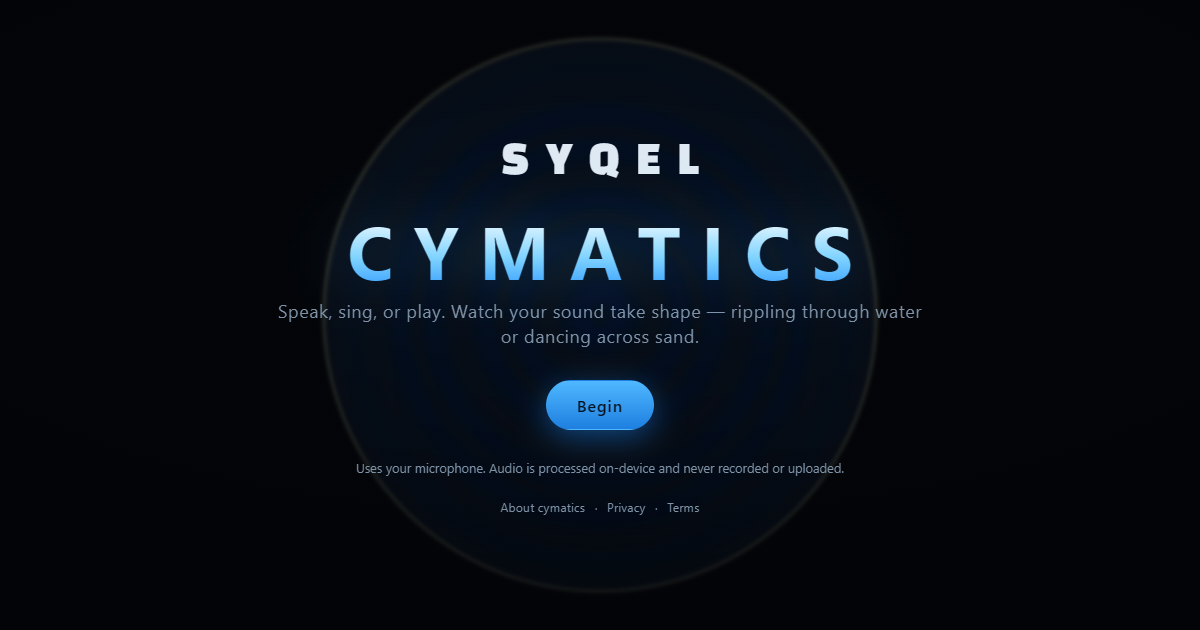
Free microphone-driven cymatics visualiser in the browser

A free browser tool by SYQEL that takes microphone input and renders it as sound rippling through water or moving across sand, with iOS and Android apps alongside the web version. The site states that audio is processed on-device and never recorded or uploaded, and offers a paid Cymatics Pro tier at 9.99 US dollars that removes advertising and allows saving snapshots. It is a simulation rather than a physical rig, so treat its patterns as illustrative, not as data.

Image: cymatics.syqel.com

Project2014Filmed in New York, USA

Cymatics: Science Vs. Music

Music video built from six filmed physics demonstrations

A music video by the New Zealand composer Nigel Stanford, shot in New York in December 2013 and finished in 2014. Six demonstrations were filmed in sequence — a Chladni plate, a speaker dish of liquid, a hose pipe shot in sync with the camera frame rate, ferrofluid, a Ruben's tube and a Tesla coil — and the music was written afterwards to fit the footage. It is the single most widely seen piece of cymatics on the internet and the reference point most newcomers arrive with.

Image: nigelstanford.com

ProjectactiveUnstated

CymaVis

Browser-based Chladni plate and water-surface simulators for teaching

An educational platform offering interactive cymatics simulators, including a Chladni plate simulator, a 3D water surface visualisation and a pattern gallery, alongside written material on the physics and the history from Chladni onwards. The site carries a 2026 copyright but does not identify the developers or an organisation behind it, which is worth noting if you plan to cite it. As a teaching aid it is convenient; the physics claims should be checked against a cited source before reuse.

Project1885–1904Wales and London, United Kingdom

Eidophone voice figures

Victorian singer's device that drew patterns from the human voice

The Welsh singer, scientist and philanthropist Megan (Margaret) Watts Hughes, 1842 to 1907, built an eidophone: an elastic membrane such as flexible sheet rubber stretched tightly over the mouth of a receiver. In 1885 she noticed what she called voice-figures or voice-flowers appearing in sand, powder, water and glycerine as she sang. She reported the work to the Musical Association, the Royal Institution and the Royal Society, published in Century Magazine in 1891 and issued The Eidophone Voice Figures in 1904. It is the direct ancestor of every voice-driven cymatics exhibit.

Image: Megan Watts Hughes, "Daisy" voice figure from Visible Sound - Voice-Figures (Century Magazine, 1891), public domain, via Wikimedia Commons

Project2009Oxford, United Kingdom

Evan Grant: Making sound visible through cymatics

The TED talk that introduced cymatics to a general audience

A talk given by Evan Grant at TEDGlobal in Oxford in July 2009, described by TED as covering "the science and art of cymatics, a process for making soundwaves visible". Grant demonstrates plate and liquid patterns on stage and argues the technique can be used analytically, for instance on dolphin vocalisations, as well as decoratively. The TED page records over 1.2 million plays, and the talk is the reason a large share of the public has heard the word cymatics at all.

Image: ted.com

ProjectactiveOpen source, online

GitHub topic: chladni-figures

The running index of open-source Chladni code

GitHub's topic page collecting public repositories tagged chladni-figures. At the time of checking it listed seven repositories across JavaScript, Python, Pascal and HTML, ranging from p5.js sketches and real-time pattern generators to wave-equation solutions applied to guitar bodies. It is the fastest way to see what code already exists before writing your own solver, and several of the listed projects are actively maintained.

Image: ratwolfzero/Chladni_Figures (GitHub repository social image)

Project1960s (archive copy dated 1967)Switzerland

Hans Jenny cymatics films

The original 1960s footage that gave the field its name

Hans Jenny, the Swiss physician who coined the term cymatics, filmed his tonoscope and plate experiments, and the resulting documentation circulates as a three-part film. The Internet Archive holds a copy catalogued with the date 1967, uploaded in May 2017 under a Creative Commons Attribution-NonCommercial-NoDerivatives 3.0 licence. The footage is the primary visual source for the whole field; note that Jenny's own interpretive framing was shaped by anthroposophy, so the images are more reliable than the commentary around them.

Image: archive.org

Project1987–presentJapan

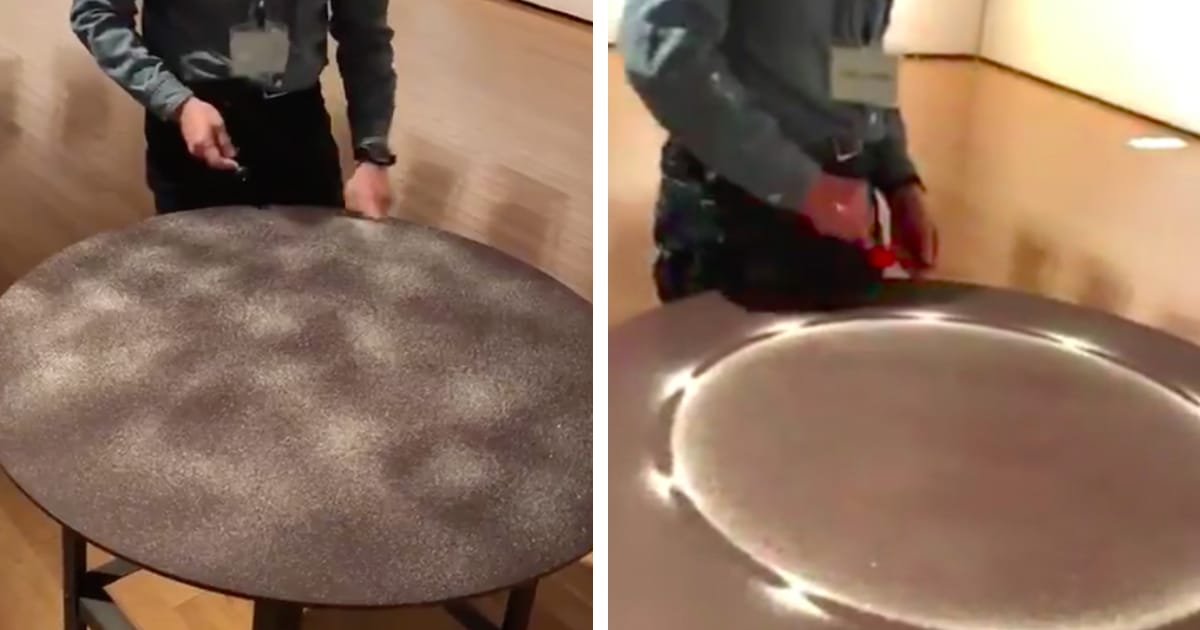
Kenichi Kanazawa: sand on steel

Japanese sculptor striking a steel table to move coloured sand

An ongoing practice by the Japanese artist Kenichi Kanazawa, who sprinkles sand across a steel tabletop and strikes it with mallets of different sizes, so each blow excites a different mode and the sand reorganises. Trained as a sculptor, he began working with steel and sound in 1987 after a collaboration with the sound artist Hiroshi Yoshimura. His clips circulate widely because the excitation is purely mechanical, with no speaker, amplifier or signal generator anywhere in the setup.

Image: mymodernmet.com

Project2000Berlin, Germany

milch (Carsten Nicolai)

Ten photographs of milk driven by sine waves from 10 to 150 Hz

A 2000 work by the German artist Carsten Nicolai, presented as a series of ten lambda prints on aluminium, each 60 by 50 cm. Milk was exposed to sine waves ranging from 10 to 150 Hz and the resulting surface structures photographed. Nicolai's own text frames the series as an experiment on the boundary between order and disorder, noting that sound almost imperceptible to the ear appears here as a permanently moving visual structure. It is one of the few cymatics works to have entered the contemporary art canon.

Image: Carsten Nicolai

Project2013Germany

NumChladni

Finite-element tool for vibrating membranes and thin plates

An interactive tool by Thomas Müller for studying arbitrary two-dimensional vibrating membranes and thin plates using the finite element method, described in an arXiv paper submitted in August 2013. It computes the vibrational patterns of different membrane geometries and was written for undergraduate physics teaching. It matters here because it handles shapes other than the square and circle, which is exactly the gap most hobby simulators leave when you start cutting vessels or plates to unusual outlines.

Image: NumChladni paper, arXiv:1308.5523 (Fig. 2a)

Project2023Argentina and France

Propagating trains of oscillons over Faraday waves

Experiment finding localised structures travelling on a Faraday pattern

An experimental study by Samantha Kucher, José Eduardo Wesfreid and Pablo Javier Cobelli, submitted to arXiv in November 2023 and revised in 2025, reporting highly localised structures travelling over a one-dimensional pattern of Faraday waves. The authors describe sharp peaks that emerge spontaneously beyond a threshold and move faster than the underlying wave drift. It is a reminder that a driven liquid surface does more than settle into tidy standing patterns, which is worth knowing before you conclude a vessel is misbehaving.

Image: Rojas, Vega, Alfaro-Bittner et al., arXiv:2311.11186

Project2011USA

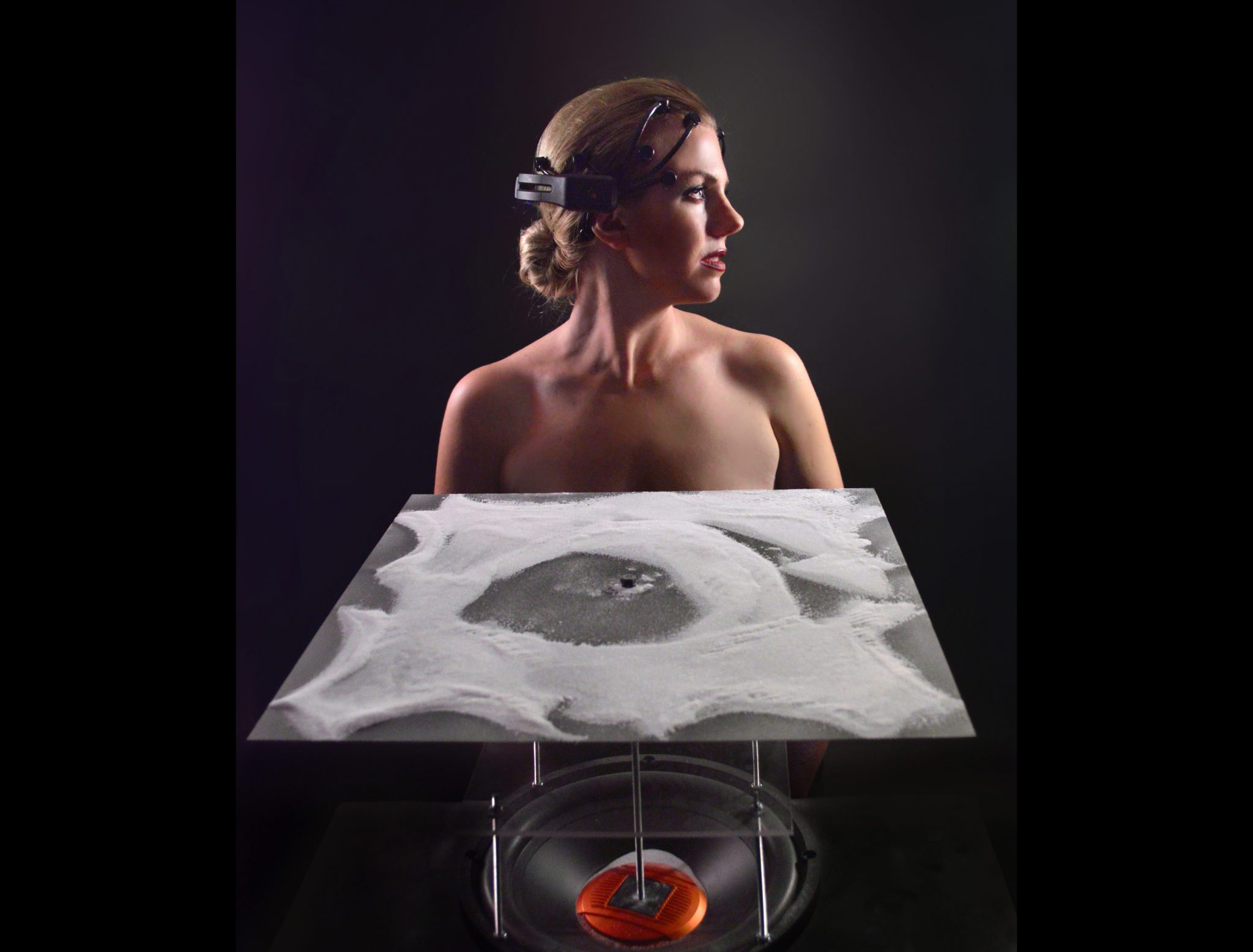
Resonation (Amy Karle)

Brainwave data driving a Chladni plate

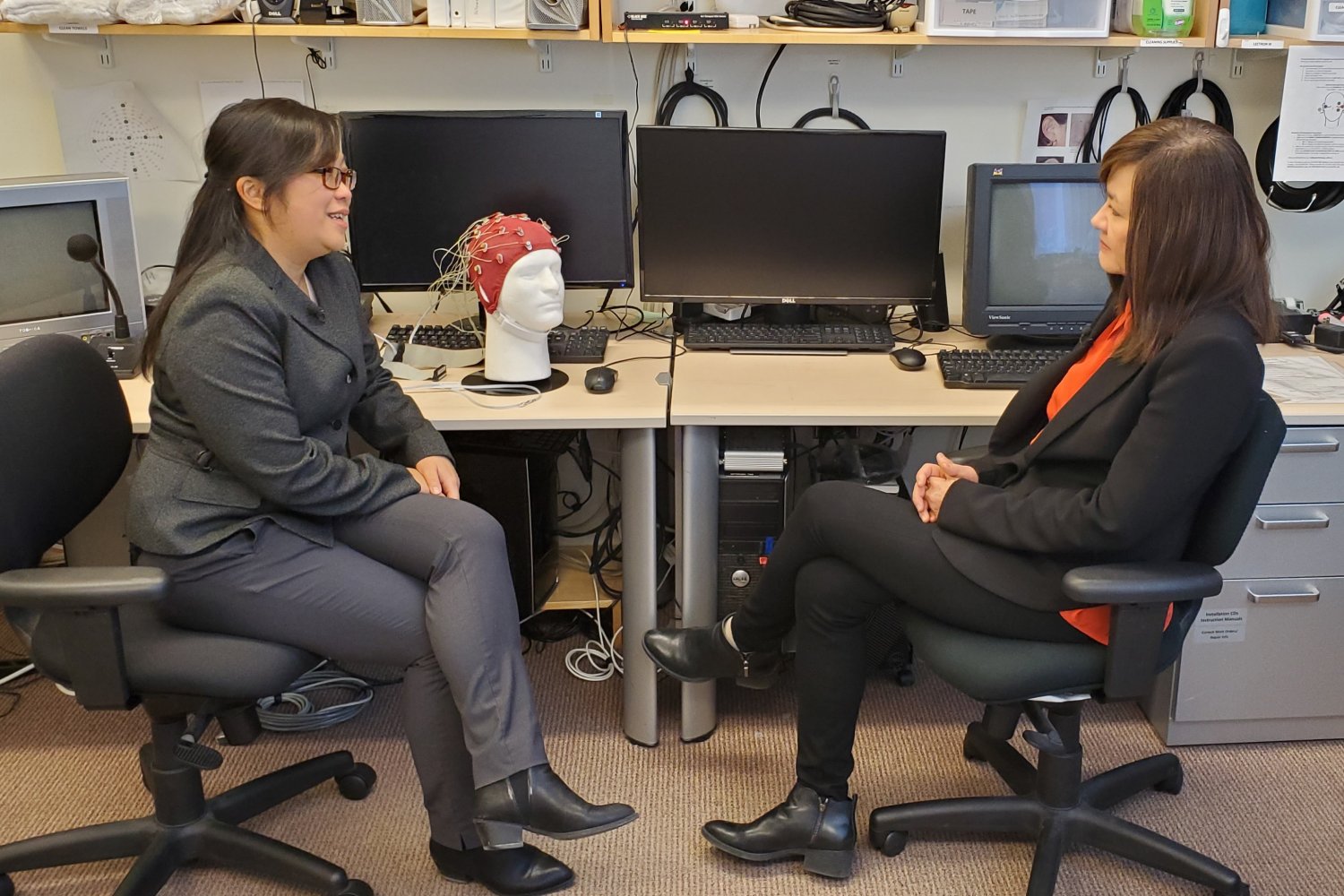
A 2011 work by the American artist and bioartist Amy Karle in which an EEG neuroheadset was connected to a Chladni plate, turning the wearer's bio-signals into visuals and sound. It is an early example of using a plate as an output device for live biological data rather than as a fixed physics demonstration, and it is the usual citation when a cymatics rig is driven by something other than a tone generator.

Image: Amy Karle

Projectacquired 1963London, United Kingdom

Science Museum Group Chladni plates

Wheatstone's own plates in the national collection

Two metal Chladni plates held by the Science Museum Group in London, accessioned in 1963 as 1963-202 and donated by King's College London. The catalogue records that they belonged to Sir Charles Wheatstone, better known for telegraphy but also a student of acoustics and optics, and describes the technique of bowing the plate edge so sand collects into symmetrical figures. The entry also notes the practical use of the method in instrument making, for instance checking that violin front and back plates behave symmetrically.

Image: Science Museum Group Collection

Project2016Chile and France

Streaming patterns in Faraday waves

Why the liquid under a Faraday pattern quietly circulates

A study by Nicolas Périnet, Pablo Gutiérrez, Héctor Urra, Nicolás Mujica and Leonardo Gordillo, posted to arXiv in March 2016, examining the net flows underneath Faraday waves. Using tracers and particle image velocimetry they identified three distinct streaming pattern types and built a three-dimensional model coupling bulk flow to boundary layers. They also found that surface contaminants materially change what is observed — a practical warning for anyone whose water dish behaves differently from one session to the next.

Image: Périnet et al., arXiv:1603.07353, Fig. 2 (via ar5iv)

Project2022USA

The Rings of Power title sequence

Television titles filmed on a purpose-built Chladni plate

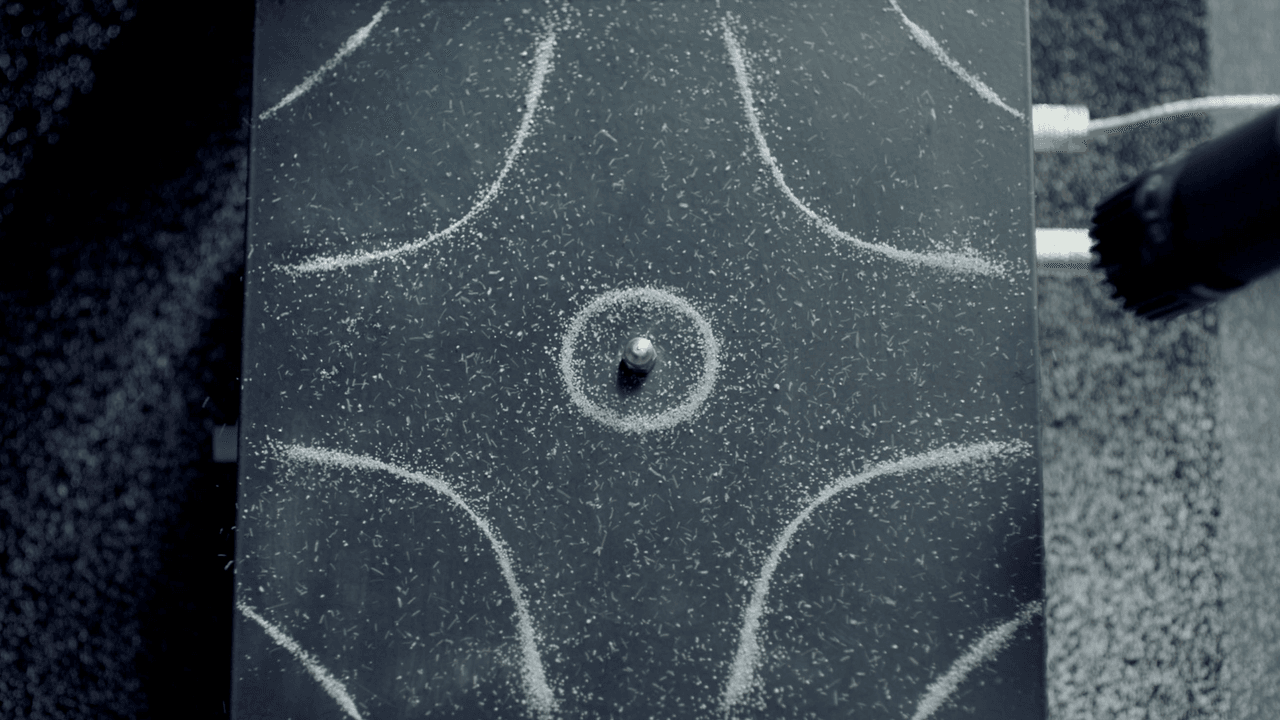
The opening titles for Amazon's The Lord of the Rings: The Rings of Power, directed by Katrina Crawford and Mark Bashore of the studio Plains of Yonder for the September 2022 premiere. The team investigated cymatics using a homemade Chladni plate and slow-motion footage to test what shapes sand would form, then built a rig roughly two feet across and programmed tones to produce basic cymatic patterns such as diamonds and swirls, filmed practically rather than simulated. It is the highest-profile commercial use of a real plate to date.

Image: Still from the title sequence, Art of the Title / Plows & Stars for Amazon Studios

ProjectactiveUnited Kingdom and Spain

Ultraino

Open hardware and software for phased-array ultrasound

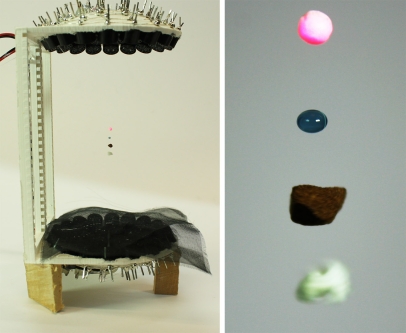
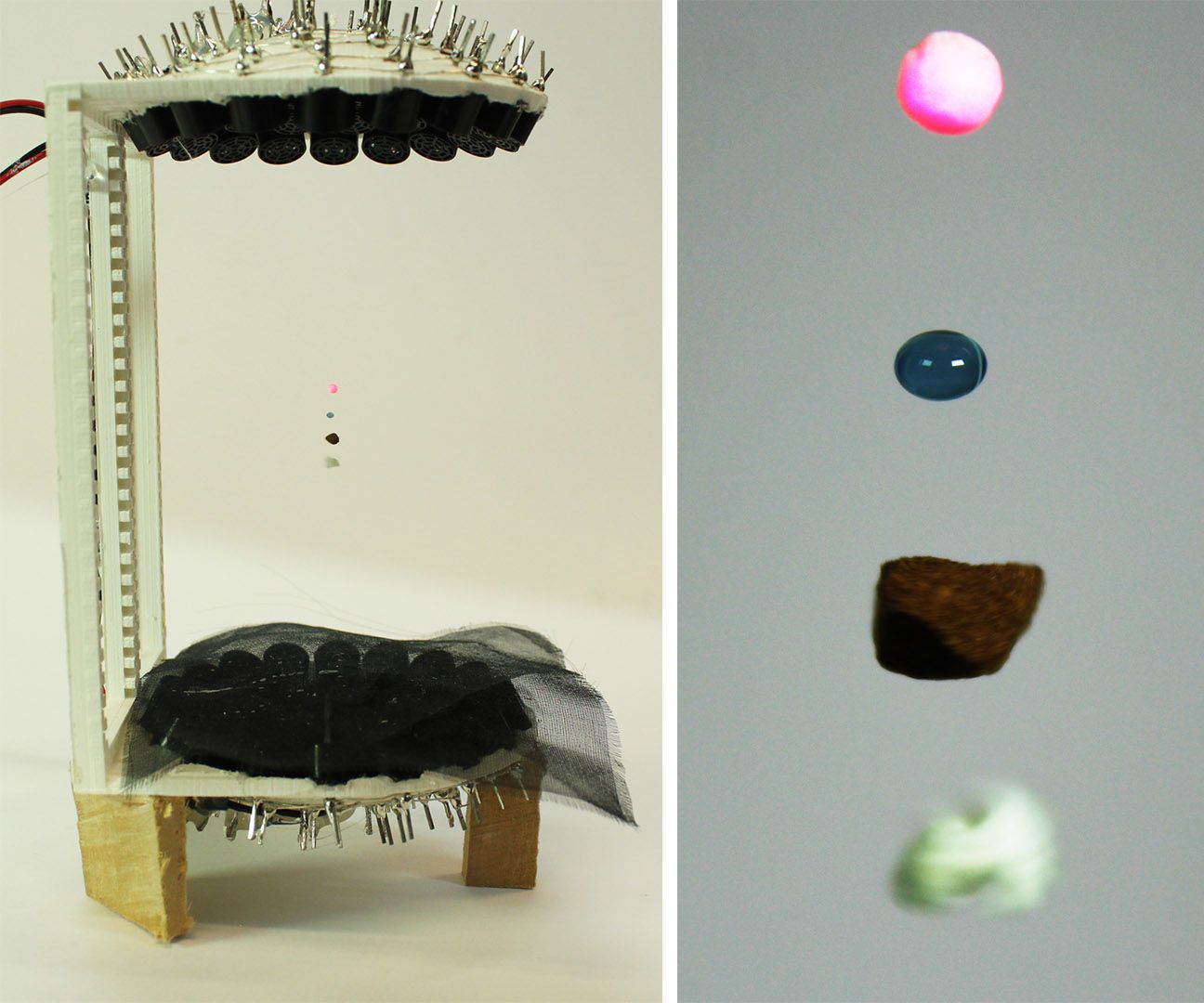
An open-source project by Asier Marzo comprising a PC-based acoustic field simulator, Arduino-compatible driver boards for 16 and 64 channels, calibration tools and example array layouts, released under the MIT licence with an accompanying IEEE paper. It is aimed at phased-array ultrasonic transducers for acoustic levitation and particle manipulation. For a studio already comfortable with Arduino, it is the most direct route from audible-frequency cymatics into acoustic levitation.

Image: Tatsuki Fushimi, CC BY-SA 4.0, via Wikimedia Commons

Project2001–2008Berlin, Germany

wellenwanne

Water-filled aluminium trays driven by speakers, by Carsten Nicolai

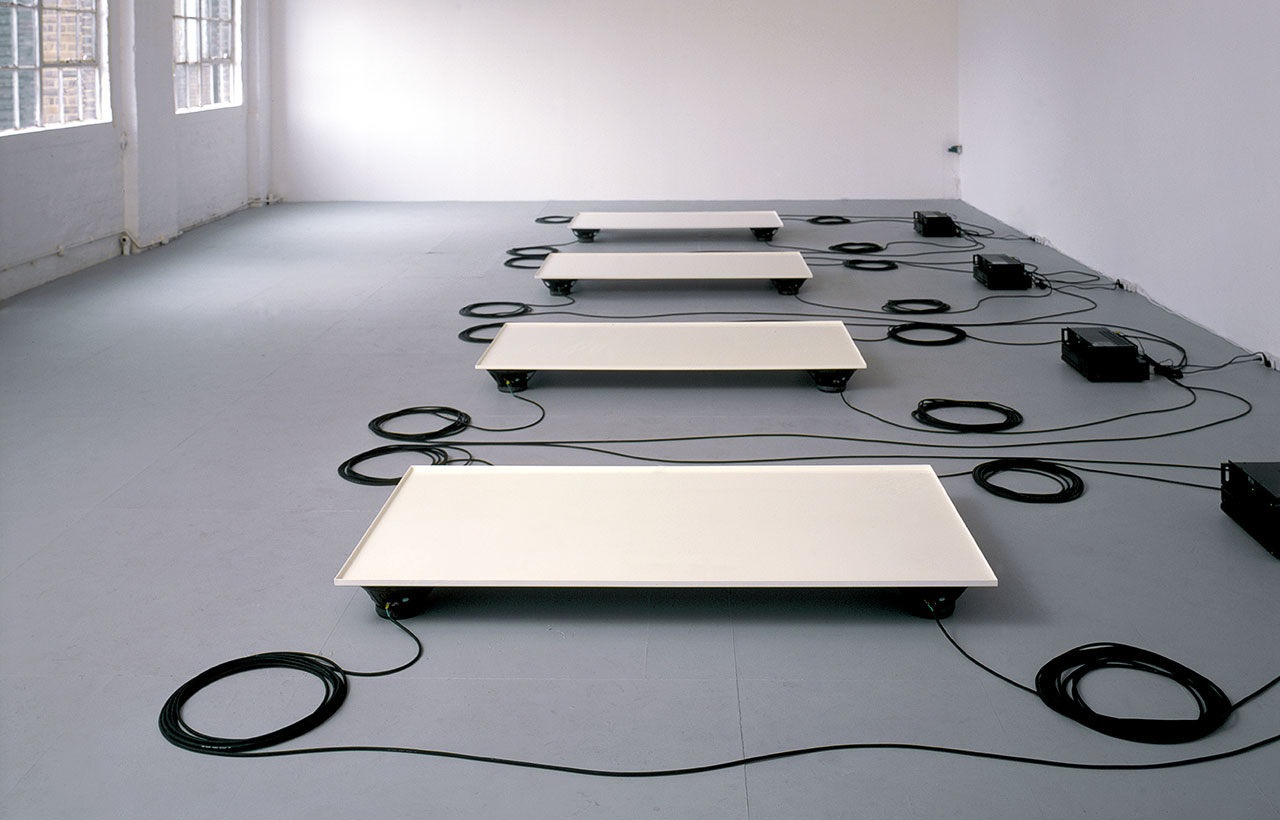
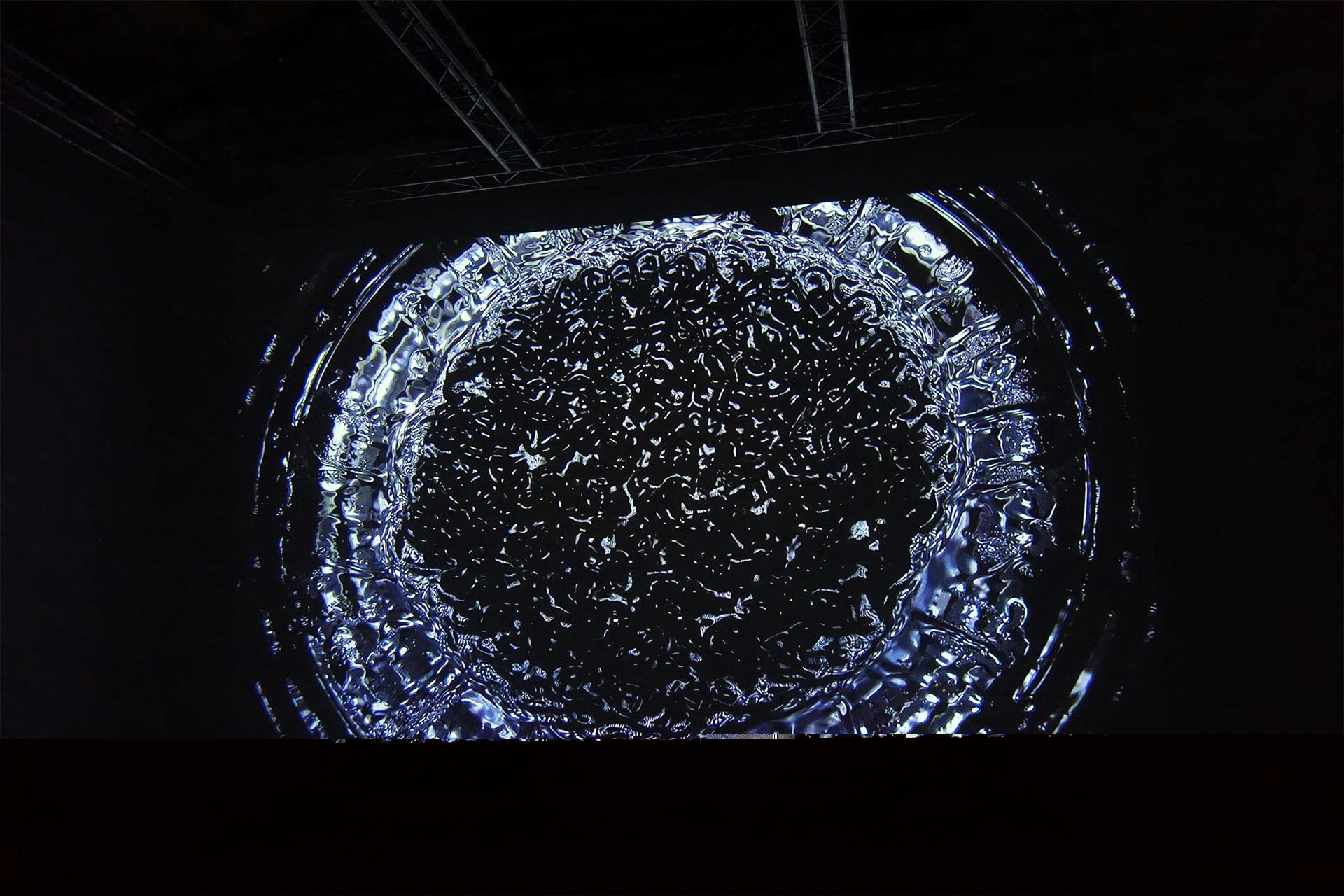
An installation by Carsten Nicolai, dated 2001/2003/2008 on his own site, consisting of aluminium trays, a CD player, amplifier, speakers and water. Loudspeakers beneath each tray transmit sound — partly inaudible — into the water, and because the sound differs per tray, each surface carries its own shifting interference pattern. The work is usually cited as the piece that moved Faraday-wave imagery from the physics lab into the gallery, and it is the direct ancestor of most vessel-based rigs built since.

Image: Carsten Nicolai / photo: Dave Morgan

Project2012Berlin, Germany

wellenwanne lfo

Water pond, four exciters and a stroboscope locked to the sound

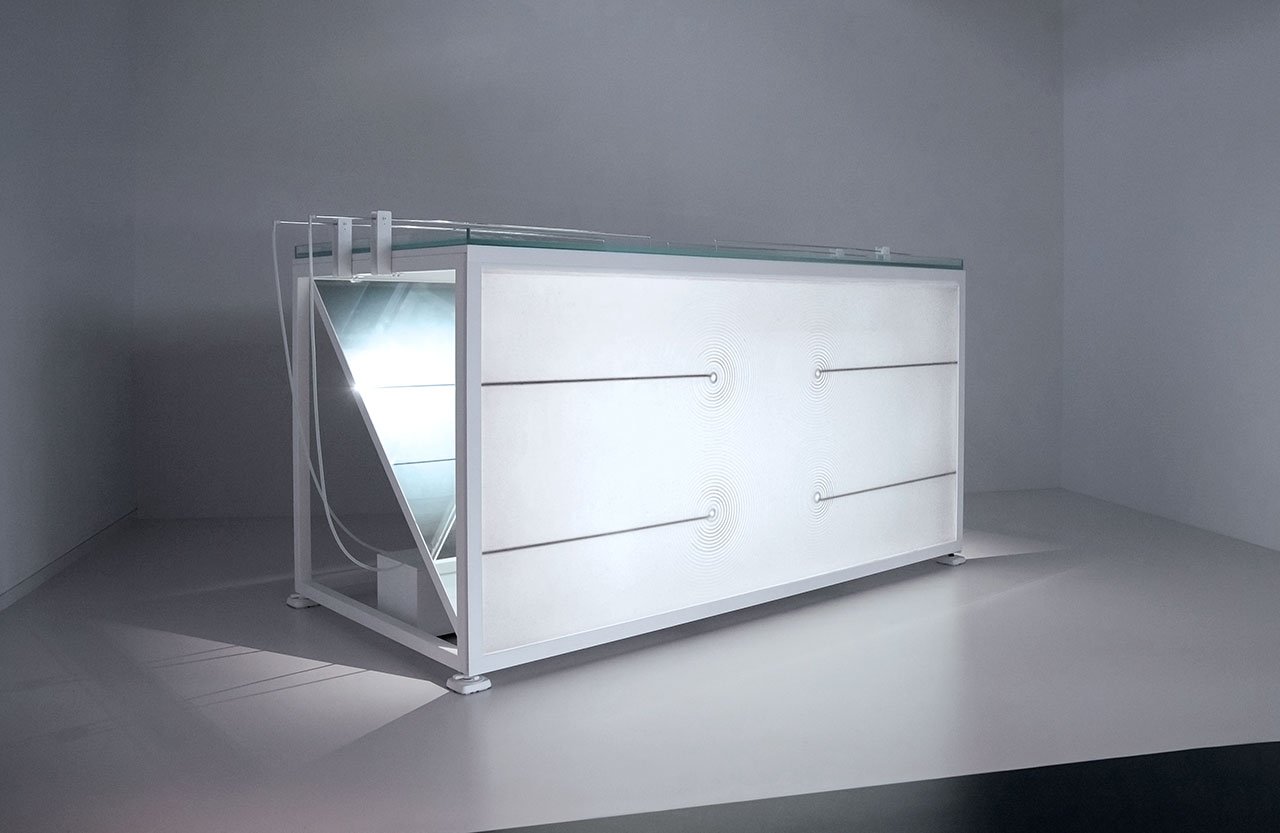
Carsten Nicolai's 2012 successor to wellenwanne, made from metal, glass, acrylic glass, mirror, audio equipment, water, light and sound. Four exciters drive two channels of sub-bass into a shallow pond; each source produces concentric circular waves that interfere where they meet, and a stroboscope synchronised to the sound freezes the pattern onto a display screen. For anyone phasing a strobe against an audio signal, this is the canonical gallery-scale precedent for the technique.

Image: Carsten Nicolai (photo: Carsten Nicolai)

Organisations 13

Organisation1979–presentLinz, Austria

Ars Electronica

Linz institution and prize where sound-art cymatics work gets shown

An Austrian cultural, educational and scientific institute for new media art, founded in Linz in 1979, running an annual festival, the Ars Electronica Center museum, the Futurelab research studio and the Prix Ars Electronica, awarded since 1987 with categories including Digital Music and Sound Art, Interactive Art and Hybrid Art. Its top award, the Golden Nica, has been called the Oscar of digital art. It is the venue and prize that most often puts vibration-based sound art in front of an international audience.

Image: Walter Isack (Isiwal), CC BY-SA 3.0, via Wikimedia Commons

OrganisationactiveUnstated

Artsonify

Studio converting songs into cymatics-inspired visual prints

An art studio that analyses a song's frequencies and converts them into colour, form and composition using cymatic logic, selling the results as visual works. Its own explainer, published in October 2025, traces the field from Ernst Chladni through Hans Jenny's 1960s research before describing its three-step process of frequency extraction, cymatic-logic conversion and artistic interpretation. Worth reading as an example of the genre, with the caveat that the output is a digital interpretation rather than a photograph of a physically vibrated medium.

Image: artsonify.com

OrganisationactiveCambridge, Massachusetts, USA

Cognito Therapeutics

Company commercialising gamma-frequency audiovisual stimulation

A biotechnology company developing Spectris, an investigational wearable headset delivering non-invasive audiovisual stimulation for one hour a day at home, intended to evoke gamma brain-wave activity in people with Alzheimer's disease. The company reports a completed feasibility study called OVERTURE and states that Spectris AD has received FDA Breakthrough Device Designation. It is included here because it is the commercial end of the same physics that hobby strobe-and-tone rigs use; the therapy remains investigational and its efficacy is not established.

Image: Cognito Therapeutics

OrganisationactiveUSA

Cymatics.fm

Sample-pack company that shares the name but not the subject

A music production company selling sample packs, plugins and free downloads, describing itself as "The #1 Site For Samplepacks, Plugins & More!" and claiming more than two million producers as customers. It is listed here purely for disambiguation: it dominates search results for the word cymatics, and nothing on its site connects it to the physics of visible sound. If you are searching for plate or water work and keep landing on drum kits, this is why.

Image: cymatics.fm

OrganisationactiveEliot, Maine, USA

CymaticSource / MACROmedia Publishing

Publisher keeping Hans Jenny's books and films in print

MACROmedia Publishing of Eliot, Maine, run by publisher Jeff Volk, operating as CymaticSource. Its main product is a revised oversize clothbound edition combining both of Hans Jenny's original volumes with a biographical portrait, a primer for non-scientists, a foreword by Ted Gioia and commentaries. It also distributes films including archival footage of Jenny demonstrating his electro-acoustic tonoscope in the early 1960s, and the English edition of Alexander Lauterwasser's Water Sound Images. Some catalogue titles move into vibrational healing, which is a separate and unevidenced claim.

Image: CymaticSource / MACROmedia Publishing

OrganisationactiveToronto, Canada

Experimental Nonlinear Physics Group, University of Toronto

University group whose Faraday wave pages are a standard reference

A research group in the Department of Physics at the University of Toronto whose public pages document Faraday wave experiments. They explain that vertically oscillating a dish of fluid effectively modulates the gravity the fluid experiences, and that above a critical drive the surface becomes unstable and waves appear at half the driving frequency. The pages catalogue stripes, squares and hexagons in Newtonian fluids, transient spirals and concentric rings, and oscillons in granular layers, tracing the effect back to Faraday in 1831.

Image: Experimental Nonlinear Physics Group, University of Toronto - Faraday wave hexagon pattern from their own experiment

Organisation1969–presentSan Francisco, USA

Exploratorium

San Francisco science museum with hands-on acoustics exhibits

Founded in 1969 by the physicist Frank Oppenheimer, the Exploratorium is a museum of science, technology and the arts built around human perception, with more than a thousand participatory exhibits and a learning-by-doing approach that has been copied by roughly four hundred science centres worldwide. It moved from the Palace of Fine Arts to Piers 15 and 17 in 2013. It matters to cymatics as the home of Chladni Singing, a permanent voice-driven plate exhibit, and as the model for how to make a plate survive public use.

Image: Wikipedia — Exploratorium

OrganisationactiveGermany

Kymat

German art project turning sound into photographed water patterns

A German art project working in cymatics through installations, live performances and fine-art prints, all generated physically on water surfaces and photographed rather than rendered digitally. Its output includes personal sound images made from a submitted voice recording, prints on Hahnemühle paper, a Wasserklangschale developed with Peter Hess, and the albums Sonic Bloom and Good Vibrations; installations have appeared at Nuit Blanche in Paris and in Hong Kong and Milan. The site names collaborators including Sven Meyer and Tim Kaiser but does not name its founders.

Image: KYMAT (Sonic Water installation)

OrganisationactiveUSA

Plains of Yonder

Title-sequence studio that filmed cymatics for Rings of Power

A creative studio working on title sequences, branding and spatial design, with credits listed for Amazon Studios, Netflix, HBO and Apple TV among others. Directors Katrina Crawford and Mark Bashore made The Lord of the Rings: The Rings of Power main titles by building a Chladni plate roughly two feet across, programming tones to produce specific patterns, and filming the sand practically. The studio's site lists the Rings of Power work for both seasons but does not give a location or ownership details.

Image: Plains of Yonder (Katrina Crawford & Mark Bashore)

OrganisationactiveUnited Kingdom

Science Museum Group

UK museum group holding historic Chladni apparatus

A group of six UK museums — the Science Museum in London, the Science and Media Museum in Bradford, the Science and Industry Museum in Manchester, the Railway Museum in York, Locomotion in Shildon, and the Science and Innovation Park — receiving over five million visitors a year. Its collection covers science, technology, engineering, mathematics and medicine, and its online catalogue is freely searchable. For cymatics it holds original nineteenth-century Chladni plates, including a pair that belonged to Charles Wheatstone.

Image: Wikimedia Commons — "Science Museum, Exhibition Road (cropped).jpg"

OrganisationactiveUnited Kingdom and USA

Sonic Age Ltd and the CymaScope

UK company selling the CymaScope instrument and cymatic imagery

Sonic Age Ltd, founded in the UK by John Stuart Reid with an American arm, Sonic Age America, makes the CymaScope, which its site calls the first scientific instrument that can provide an analog image of sound and vibration by imprinting vibrations onto water. The company's team page lists Reid, Vera Gadman, James Stuart Reid and Annaliese Reid. Its imaging work is real, but the site's wider claims — applications in sound therapy, and the framing of the instrument as comparable to the invention of the microscope — are the company's own and are not established science.

Image: Sonic Age Ltd / cymascope.com, via the Internet Archive Wayback Machine

OrganisationactiveUnited Kingdom

SoundMadeVisible

Shop selling CymaScope hardware, kits and cymatic prints

The retail arm associated with the CymaScope, trading as SoundMadeVisible with the strapline "We make sound visible". Its catalogue runs from a CymaPlate Kit Model M at £177, containing a blue-faced plate, table stand, violin bow, rosin, a particulate sprinkler and a STEAM class guide, up to a Water Wonders Kit at €1,110 and the CymaScope Pro. It also sells personalised "DNA Voice Signature" images. The kits are usable teaching hardware; the voice-signature products are marketing framing rather than a scientific service.

Image: SoundMadeVisible

OrganisationactiveCambridge, Massachusetts, USA

Tsai Laboratory, MIT

MIT lab studying 40 Hz light and sound stimulation of the brain

The laboratory of Li-Huei Tsai at MIT, working on network-level approaches to neurological disorders, and the origin of the widely cited research on 40 Hz gamma-frequency light and sound stimulation. Its news pages report that 40 Hz stimulation improved cognition, neurogenesis and connectivity in disease models, that some Alzheimer's volunteers continued the stimulation for around two years, and that evidence is accumulating across many labs. This is the one place where a flickering-and-buzzing rig has a serious clinical literature; it is still an active research question, not a settled treatment.

Image: tsailaboratory.mit.edu

Products 44

Productactive

Ableton Live

Music production software with Session and Arrangement views

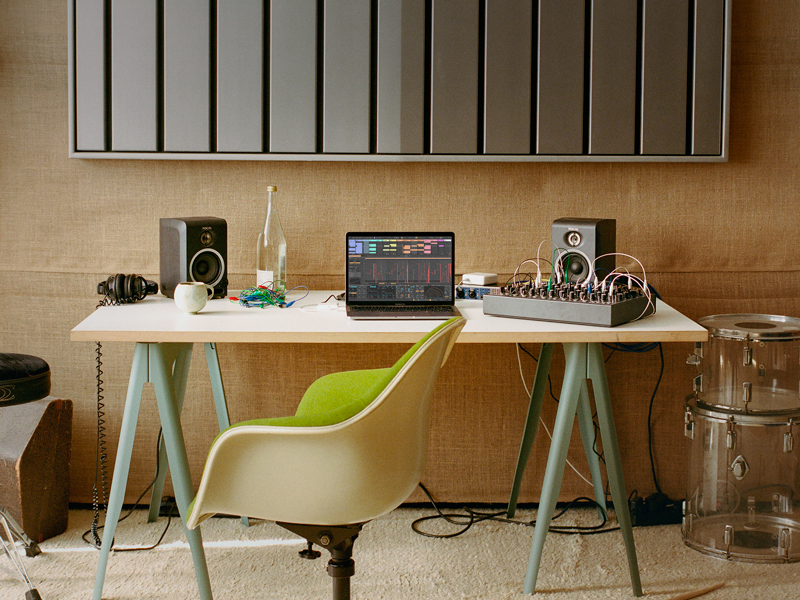
Ableton Live is a digital audio workstation used both in the studio and on stage, with a Session view for clip-based improvisation and an Arrangement view for linear editing, plus instruments and effects and MIDI transformation tools. Multiple editions exist, with Suite offered on a rent-to-own basis, and Max for Live is an add-on for building custom devices. Prices are not shown on the overview page. It appears in cymatics work as the practical way to build and recall a set of test tones, sweeps and drones and to perform them live against a plate or vessel.

Image: ableton.com

Productactive

Adafruit NeoPixel Ring – 24 x 5050 RGB LED

Chainable 24-pixel addressable LED ring, about US$17

Adafruit product 1586 is a circular board of 24 individually addressable 5050 RGB LEDs, 2.6 inches across the outside and 2.1 inches inside, about US$17. Each LED carries its own driver chip with constant-current drive, and rings chain together so several run from one microcontroller pin. Ring geometry is the reason it appears here: a ring sits concentrically around a cuvette or dish and lights the water surface evenly from above or below, and per-pixel control lets colour be swept around the ring in time with the driving frequency.

Image: adafruit.com

Productactive

Arbor Scientific Chladni Plates Kit

Square and round 24 cm plates with holders and sand, about US$99

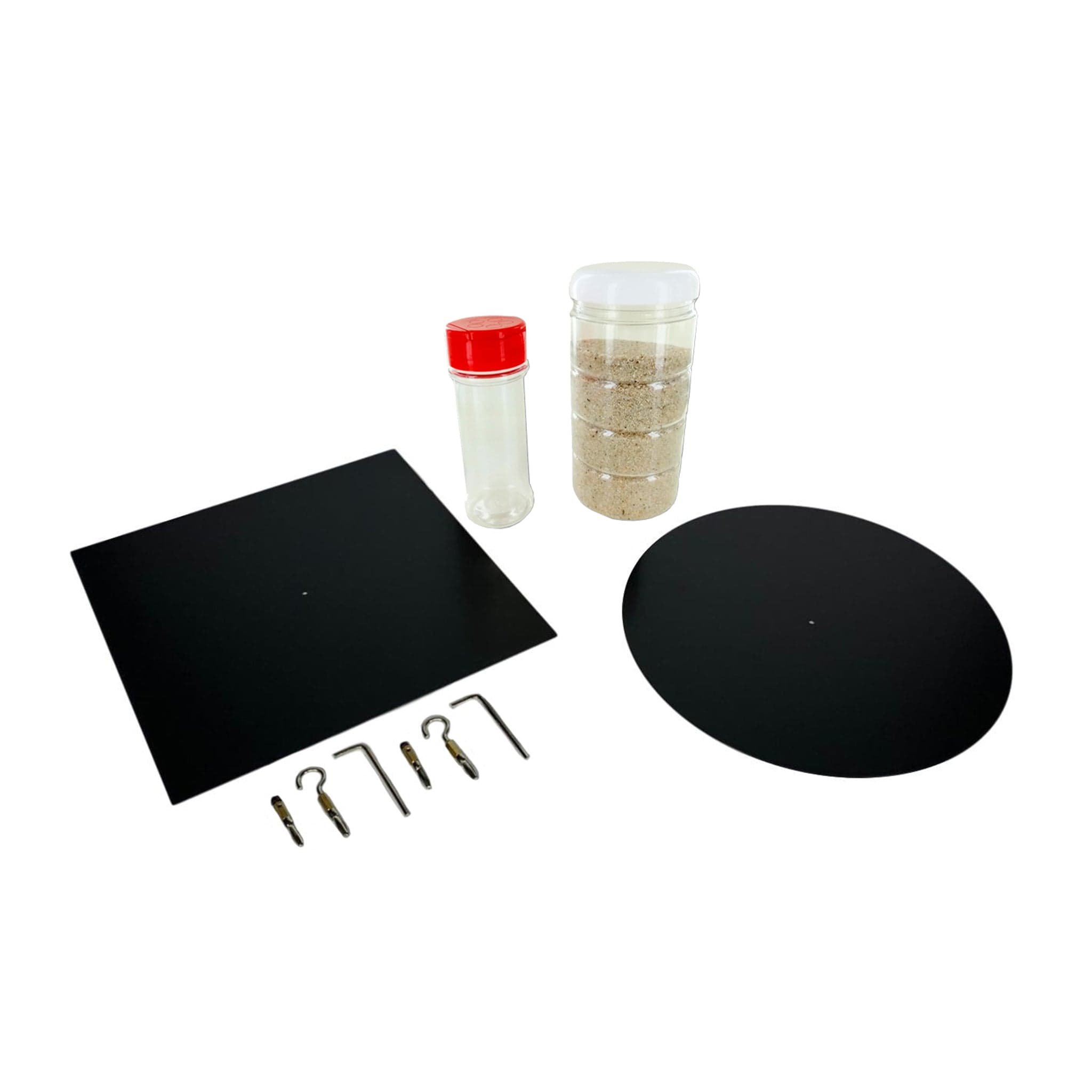
Arbor Scientific's Chladni Plates Kit is about US$99 and contains one square 24 cm plate, one round 24 cm plate, four holders, two Allen keys, a bottle of extra-fine sand and a shaker bottle. Like the PASCO set, the plates are passive: the page states you also need a signal generator and a wave driver, and recommends its own Sine Wave Generator (about US$133) and Mechanical Wave Driver (about US$149). Of the mainstream lab kits this is the one with a published price, which makes it a useful baseline when costing a first Chladni bench.

Image: arborsci.com

Productactive

Arbor Scientific LED Stroboscope

0.1–500 Hz LED strobe with remote lamp head, about US$379

A microcontroller-timed strobe with an 1100 lumen LED head on a 1.2 m lead, separate from its control unit, at about US$379. It flashes from 0.1 Hz to 500 Hz with 0.1 Hz resolution, can capture an external frequency, and lets flash duration be varied. The remote head can be clamped in a ring stand or set on the bench. This is exactly the tool for phasing a strobe against a driven plate or water surface so the pattern appears frozen or crawls slowly, which is the standard way to photograph and read Faraday waves.

Image: Arbor Scientific

Productactive

Arbor Scientific Mechanical Wave Driver

Electromechanical actuator for plates, strings and springs, about US$149

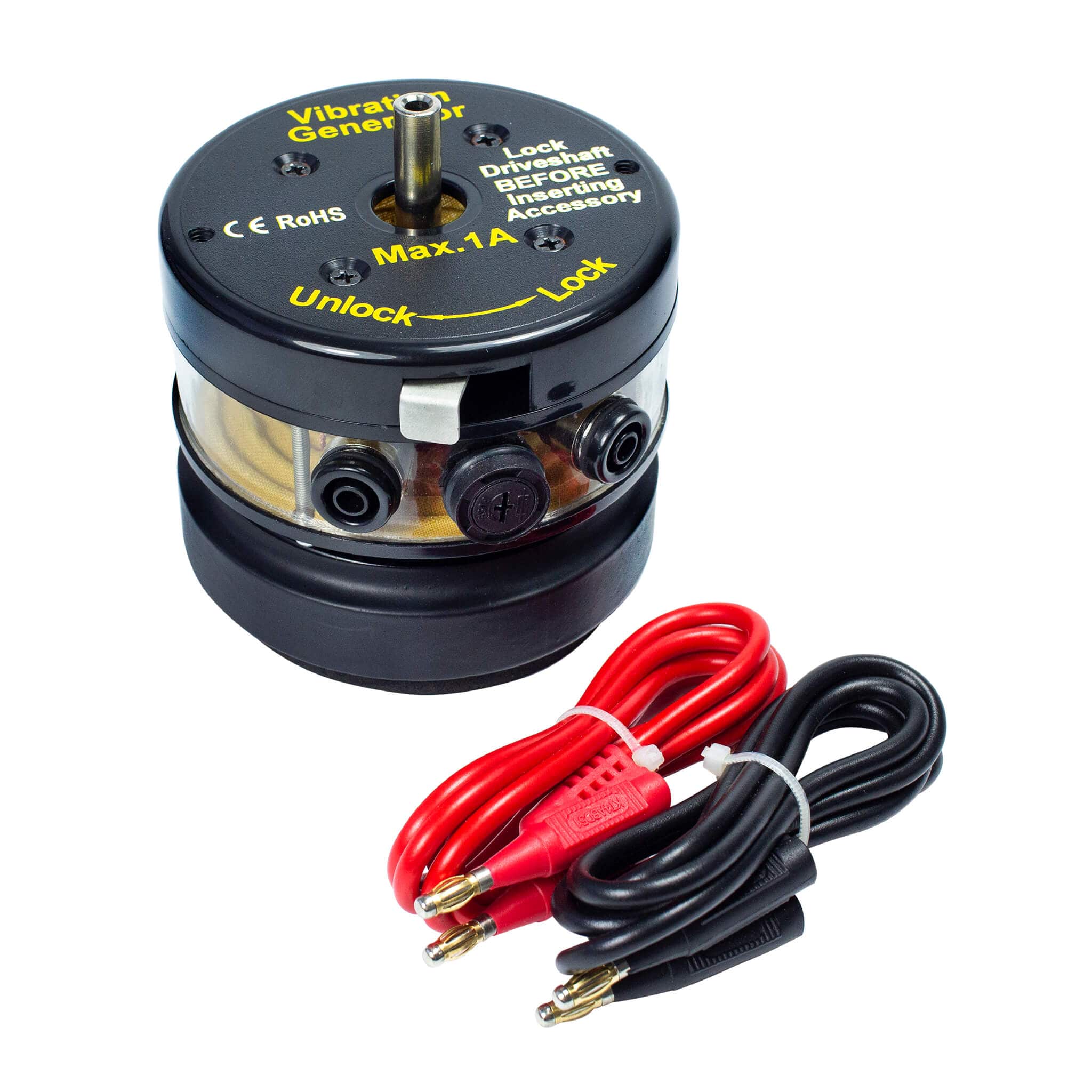
The Mechanical Wave Driver (item P7-1000) is about US$149 and turns a signal-generator output into visible mechanical motion. It takes a 4 mm banana plug on the top shaft and has an M6 threaded hole underneath for mounting, is 9 cm across and 10 cm tall, and is fused at 1 A. It does not generate anything on its own and must be fed by a separate signal generator. For a cymatics rig it is the standard way to couple a driven plate or a string to a signal source without improvising a speaker mount.

Image: arborsci.com

Productactive

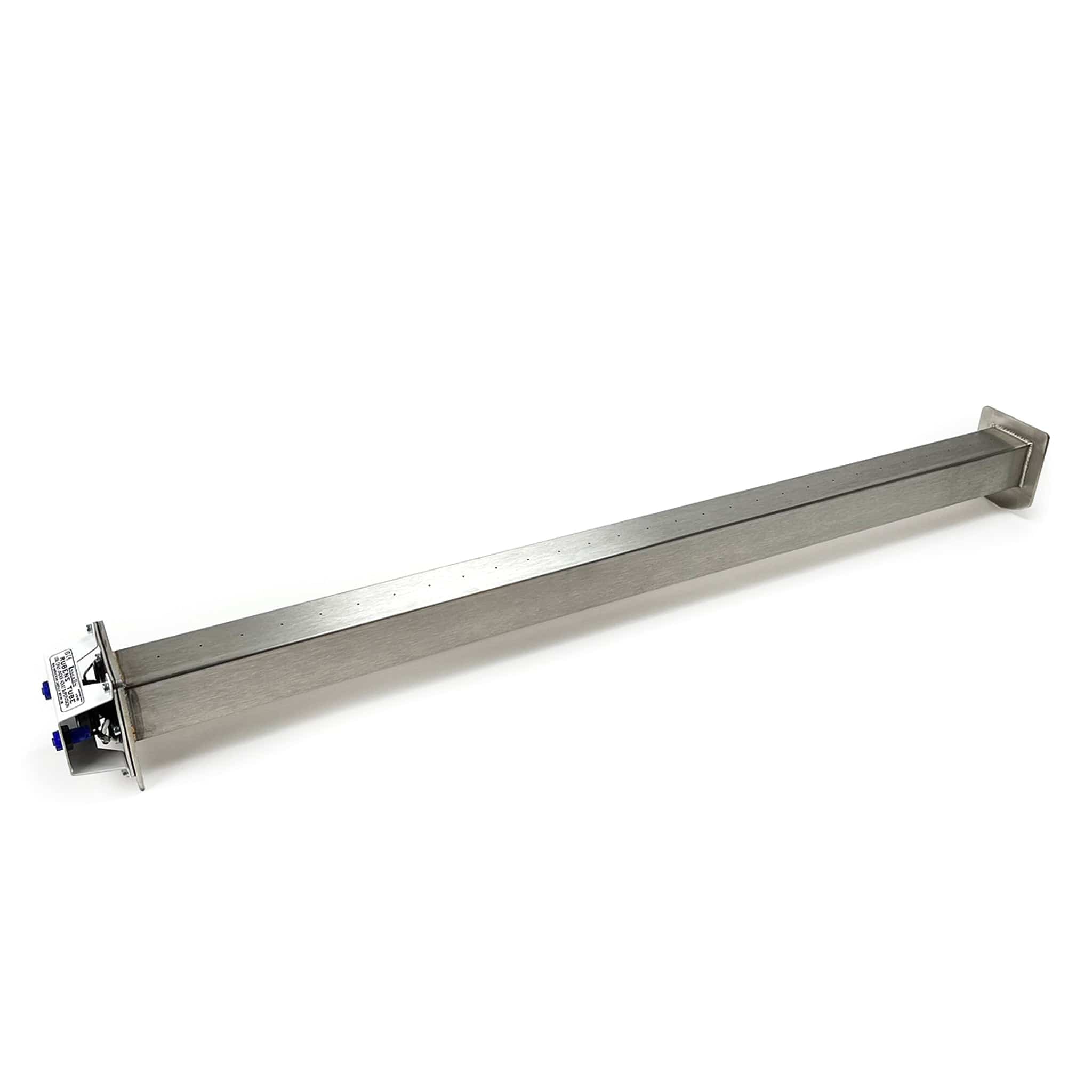
Arbor Scientific Rubens Tube

Standing-wave flame tube that shows sound as a row of flames, about US$499

The Rubens Tube is a gas-filled standing-wave tube, about US$499, whose row of flames rises and falls with the acoustic pressure inside, making compression and rarefaction visible along the tube's length. Arbor pitches it at college demonstrations and outreach events with large audiences. Its page is explicit about the hazards: instructor operation only, a regulated flammable gas supply, good ventilation and fire equipment on hand. For a cymatics studio it is the one-dimensional cousin of a Chladni plate, and it reads well on camera.

Image: arborsci.com

Productactive

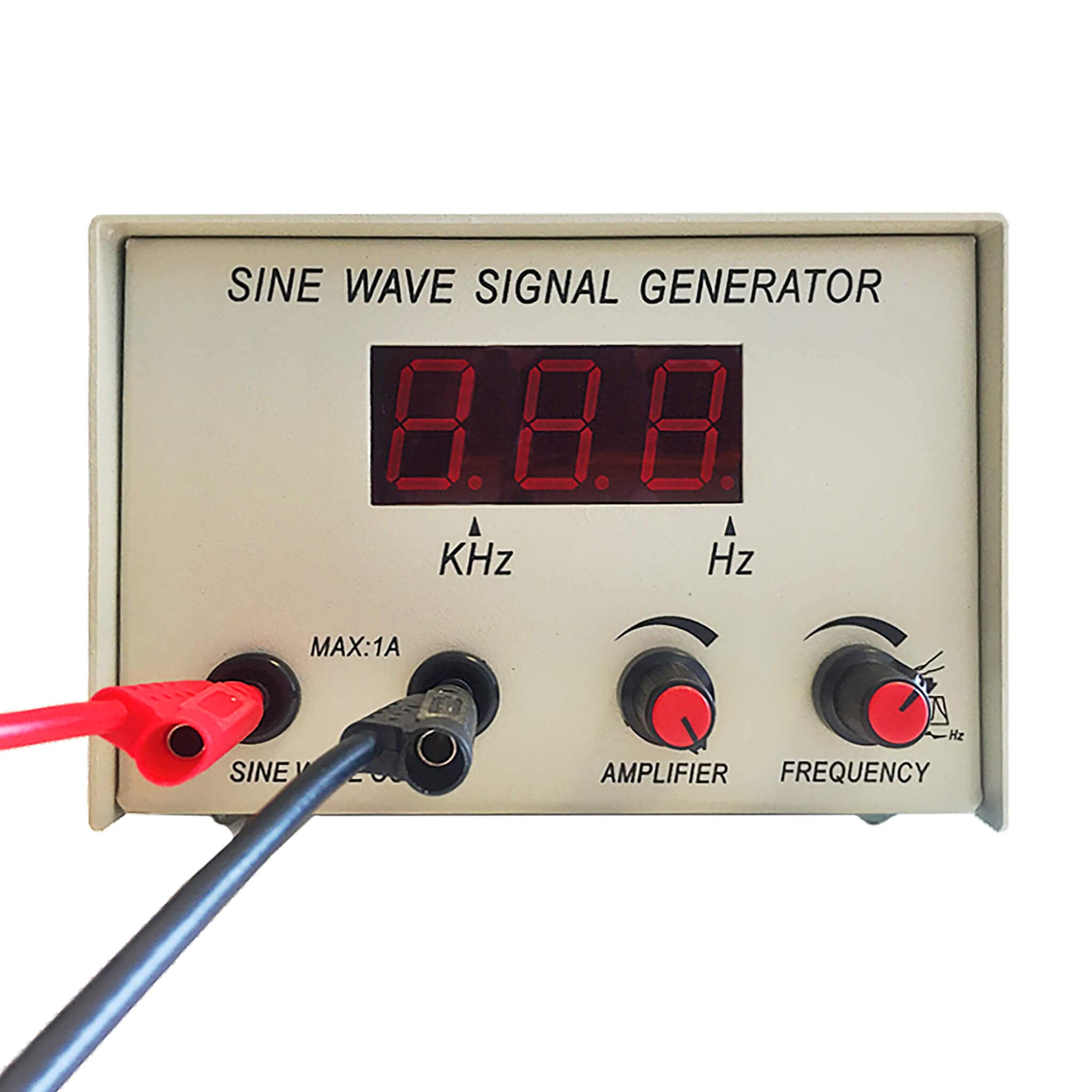
Arbor Scientific Sine Wave Generator

Two-range classroom sine source, 1–4000 Hz, about US$133

Item P7-2000 is a simple sine-only generator built for classroom wave work, at about US$133. It has two ranges: 1 to 400 Hz with 1 Hz resolution, and 10 to 4000 Hz with 10 Hz resolution, with adjustable amplitude, and the supply is rated 1 A maximum. It is designed to drive a speaker or Arbor's Mechanical Wave Driver directly. The 1 Hz steps at the low end matter for cymatics, because plate and water-vessel resonances are often narrow and easy to step over with a coarse control.

Image: arborsci.com

Productactive

Arduino UNO Rev3

ATmega328P microcontroller board, about €29

The UNO Rev3 is the baseline Arduino board: an ATmega328P at 16 MHz with 14 digital I/O pins (six PWM), six analogue inputs, 32 KB flash, 2 KB SRAM and 1 KB EEPROM, at about €29 including VAT from the Arduino store. It is the most documented board in the range, which matters when adapting somebody else's LED-ring or strobe sketch. In a cymatics rig it typically drives an addressable LED ring, sequences a strobe against a known drive frequency, or steps a signal source through a list of test tones.

Image: store.arduino.cc

Productactive

ButtKicker Mini LFE

Compact haptic transducer with a magnetically suspended piston, about US$110

The Mini LFE is a small ButtKicker transducer, about US$110, sold for sim racing and flight simulation. Its specification table gives 10 to 200 Hz and 4 ohms, with the description text quoting roughly 5 Hz to 200 Hz; it weighs 2 lb with a 6 oz piston, needs at least 50 W and takes up to 250 W, and no amplifier is included. Unlike a cone driver it works by moving a suspended mass, which makes it useful for shaking a whole rig, table or tank frame rather than a single membrane.

Image: thebuttkicker.com

Productactive

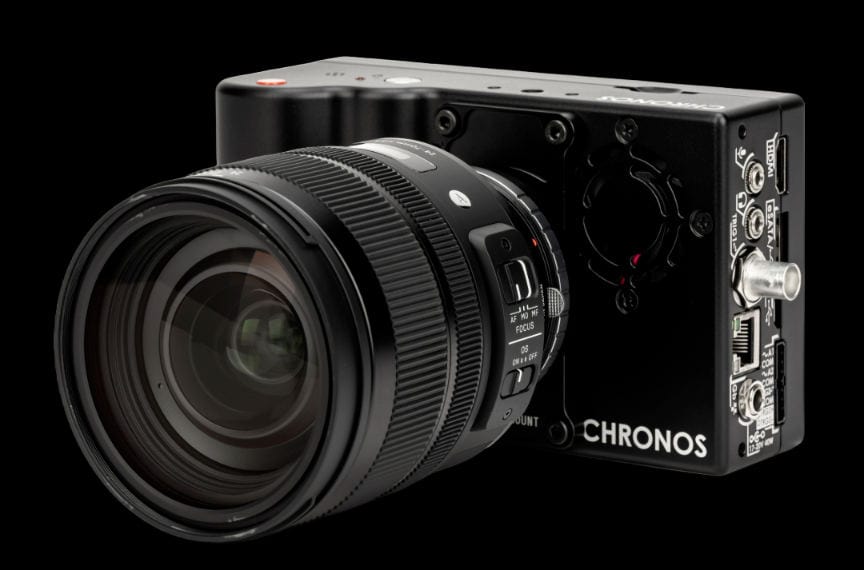
Chronos 2.1-HD

Portable high-speed camera, 1920x1080 at 1000 fps

The Chronos 2.1-HD from Kron Technologies is a self-contained high-speed camera recording 1920 by 1080 at 1000 frames per second for up to about 11 seconds, on a four-thirds sensor, with C, CS, F, EF and MFT lens mounts and output as raw CinemaDNG, H.264 or TIFF. Prices are not published; the site directs buyers to a quotation. Kron also lists the cheaper Chronos 1.4 and the Chronos 4K12 at 4K and about 1006 fps. It is the usual entry point for filming Faraday waves, bursting bubble films and sand jumping on a plate.

Image: Kron Technologies (krontech.ca)

ProductactiveUnited Kingdom

CymaPlate Kit – Model E

Electronically driven Chladni plate with oscillator and amplifier, about £688

Model E is the powered CymaPlate: about £688 for a plate, a modal exciter on levelling feet, a menu-driven electronic oscillator, a power amplifier, cable pack, coloured sand, a sprinkler and a glitter vial. The oscillator steps in 1 Hz increments, so a user can sweep slowly and stop on each resonance rather than hunting by ear. Units are hand-assembled and the page states they ship within 28 days. This is the closest thing to a turnkey driven Chladni rig for a studio that does not want to source exciter, amp and signal generator separately.

Image: soundmadevisible.com

ProductactiveUnited Kingdom

CymaPlate Kit – Model M

Bowed Chladni plate kit for home and classroom, about £177

The entry-level CymaPlate kit is a bowed Chladni plate rather than an electronically driven one. The kit costs about £177 and includes a blue-faced CymaPlate, a compact table stand, a violin bow with rosin, a refillable particulate sprinkler, a glitter vial, instructions for fixing patterns as permanent artwork, and a short STEAM class on the physics involved. It is aimed at ages nine and up, at home, school or college. For a cymatics maker it is the cheapest way to get repeatable nodal-line patterns without building a driver and amplifier chain.

Image: soundmadevisible.com

Productactive

CymaScope App

Mobile app that renders sound as cymatic imagery, iOS and Android

The CymaScope App is a phone and tablet application that displays a cymatic-style visualisation of sound. Its product page states a working span from 27 Hz to 2217 Hz and says it can show the fundamental frequencies of musical instruments as well as gongs and similar instruments. It is available through the App Store and Google Play. No price is published on the shop page. It is worth treating as a visualiser rather than a measurement instrument: the imagery is generated, not photographed off a real water membrane.

Image: soundmadevisible.com

ProductactiveUnited Kingdom

CymaScope Pro

Three-module research CymaScope for low, mid and high audio bands

CymaScope Pro is the research-grade version of the CymaScope, described on its product page as "the world's first commercial instrument that can make sound visible across the ELF, MF and HF audio bands". It ships with three interchangeable water imaging modules, each optimised for one frequency band so the wavelets on the water stay crisp. The page states plainly that it is not a plug-and-play device, is unsuitable for live stage use, and needs ancillary equipment and training. No price is published; buyers are asked to request a quotation.

Image: soundmadevisible.com

Productactive

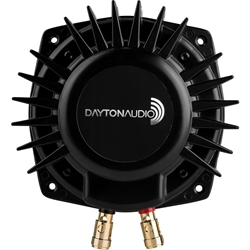
Dayton Audio BST-1

50 W tactile bass shaker, 10–80 Hz, about US$78

The BST-1 is a bass shaker rather than a loudspeaker: it has no cone and transmits low-frequency energy straight into whatever it is bolted to. It handles 50 W RMS at 4 ohms, is quoted at 10 to 80 Hz with an unmounted resonance of 30 Hz, measures 6.3 inches across by 2.34 inches high and weighs 3.75 lb, at an MSRP of about US$78. For cymatics that low-end reach is the point: it will move a heavy plate, a tank base or a table at frequencies where an exciter runs out of authority.

Image: daytonaudio.com

Productactive

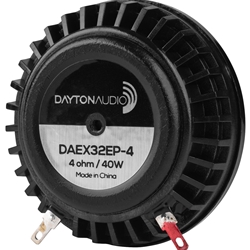
Dayton Audio DAEX32EP-4 Thruster

32 mm, 40 W audio exciter that turns a rigid panel into a radiator

The Thruster is a 32 mm voice-coil exciter rated 40 W RMS at 4 ohms, with 3.3 ohms DC resistance, a 60 mm overall diameter, 23 mm depth, a free-air resonance of 395 Hz and a BL of 4.2 Tm. It sticks to a surface with 3M VHB adhesive and drives that surface as the diaphragm. Dayton notes that thin materials sound brighter while thick ones give fuller range. Cymatics makers use exciters like this to drive plates, membranes and vessel walls from underneath without a visible speaker cone in shot. No price is listed on the manufacturer page.

Image: daytonaudio.com

Productactive

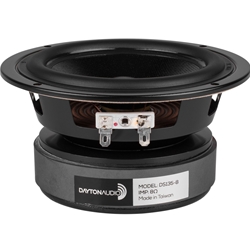
Dayton Audio DS135-8 5" Woofer

Inexpensive 5-inch woofer, Fs 52.5 Hz, about US$49

A plain 5-inch woofer, 50 W RMS and 100 W maximum at 8 ohms, 86.6 dB sensitivity, quoted from 50 to 7000 Hz with a free-air resonance of 52.5 Hz and 4.85 mm Xmax, at about US$49 MSRP. It is included here because a great many water-cymatics rigs are simply a driver like this mounted face-up with a dish or cuvette sitting on it. The published Thiele-Small figures — Fs and Xmax in particular — let a maker predict how much surface excursion is available at the frequencies they intend to use.

Image: daytonaudio.com

Productactive

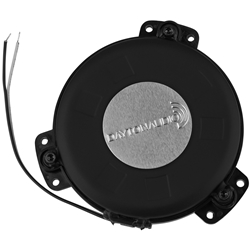
Dayton Audio TT25-8 PUCK

Small 15 W tactile transducer, 20–80 Hz, about US$24

The PUCK is a compact tactile transducer, 3.5 inches across and 1 inch high, rated 15 W RMS and 30 W maximum at 8 ohms, quoted from 20 to 80 Hz with a 40 Hz resonance, and fixed through six mounting holes. MSRP is about US$24. Its size and price make it the obvious first transducer for small experiments: a shallow dish, a stretched membrane, a bubble film frame or a lightweight plate can be driven from a single puck and a modest amplifier before committing to a larger shaker.

Image: daytonaudio.com

ProductactiveUnited Kingdom

Dr Zigs

UK maker of plant-based giant bubble mix and wands

Dr Zigs is a UK company (registered number 09083207) selling eco-focused bubble products: concentrated plant-based bubble mix, ready-to-use solutions, giant and mini bubble kits, a frozen bubble kit, an educational pollinator kit, plastic-free beach toys and clothing. It states its products are non-toxic, vegan, cruelty-free and ethically sourced, packaged in recyclable materials. It is the most accessible European source of large-format bubble mix and giant wands, which is what a studio needs when working with sheet films big enough to show driven standing waves across their surface.

Image: drzigs.com

Productactive

edgertronic

High-speed cameras up to 35,000 fps with a browser interface

edgertronic makes high-speed video cameras for industrial, scientific, defence and visual-arts work, in five models from SC1 to SC2X, quoting up to 35,000 fps and resolutions up to 1920 by 1080. They use a global shutter, take Nikon F-mount lenses, are configured through a web interface rather than proprietary software, and include a built-in dark-frame shutter; a hard case, Ethernet cable, power supply, 50 mm lens and remote trigger are supplied. No prices are given on the site. The web interface matters for cymatics because the camera can be triggered and adjusted from the same laptop that is driving the rig.

Image: edgertronic (Sanstreak Corp.)

Productactive

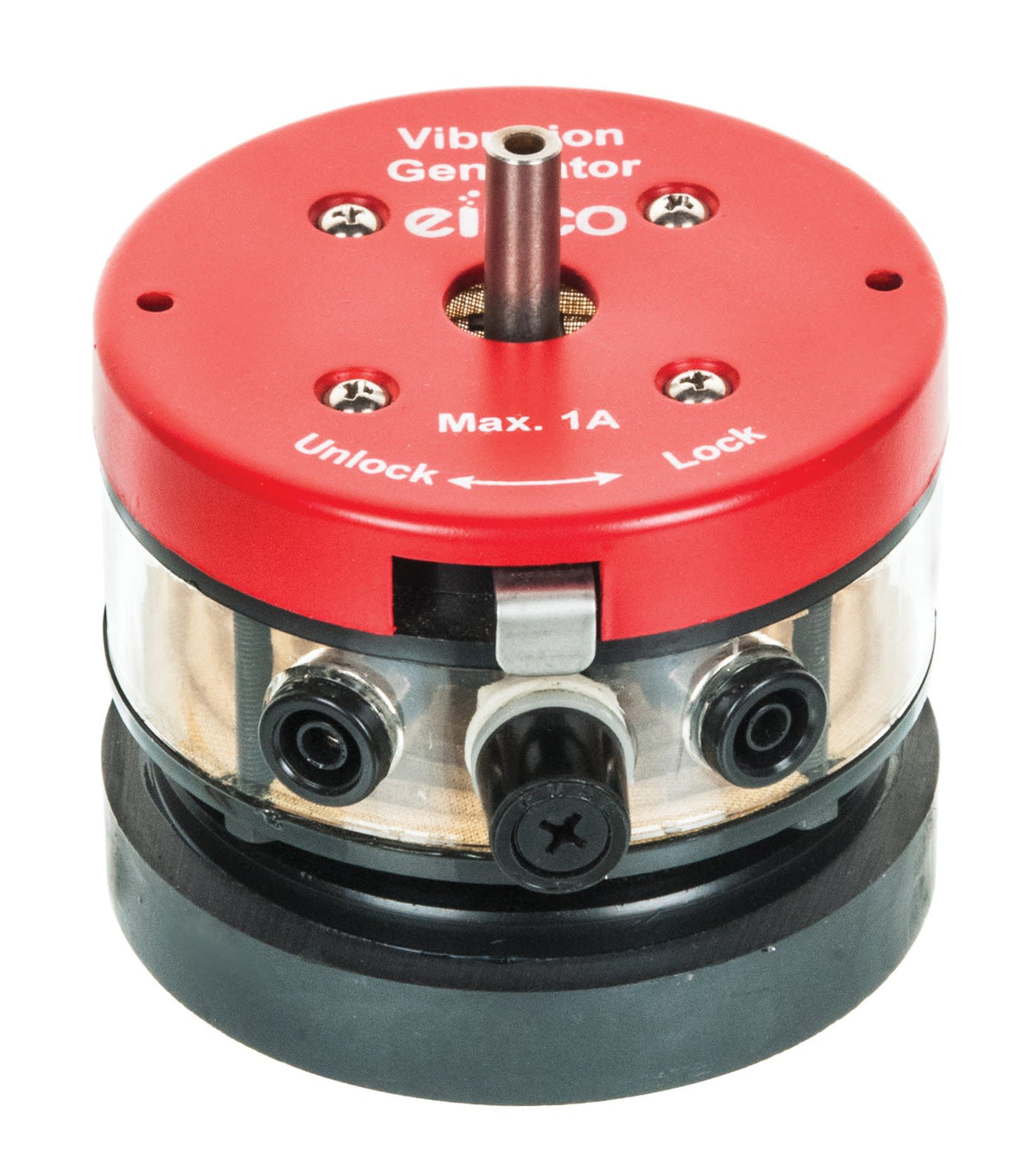
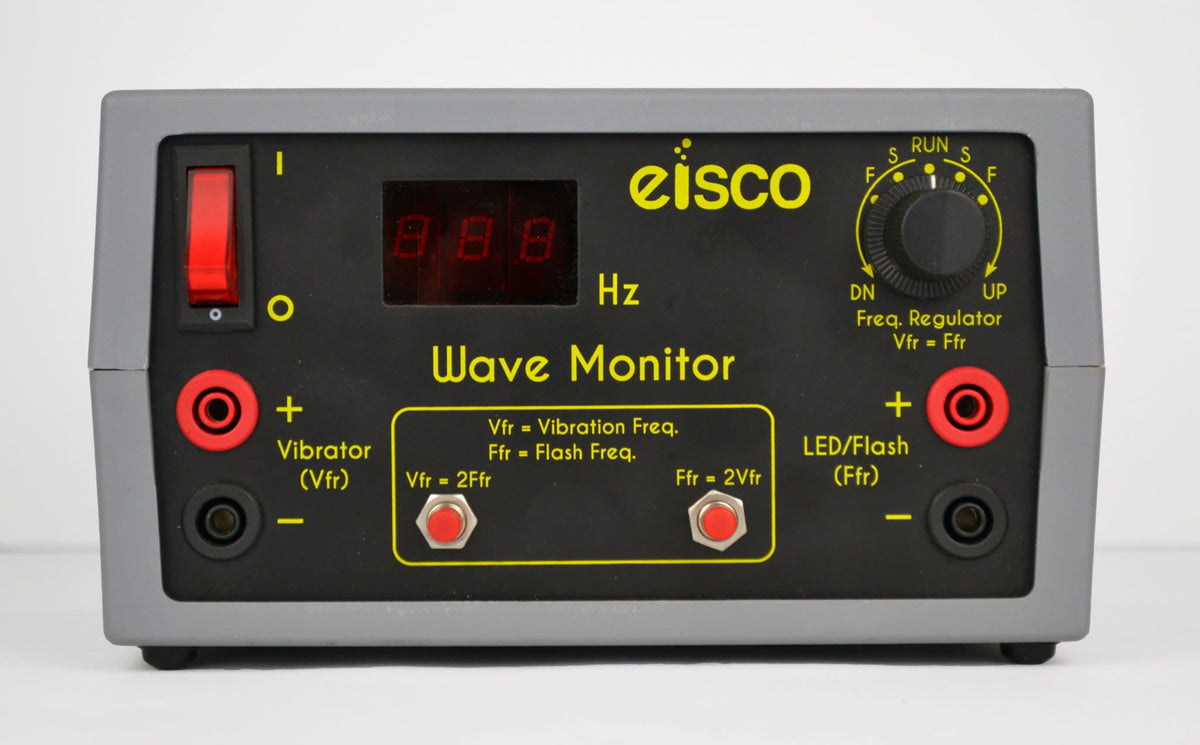
Eisco Labs Vibration Generator (VBGN)

3 ohm mechanical oscillator for Chladni and standing-wave work

Eisco's vibration generator works like a speaker motor with a bare output shaft: a coil in a magnetic field, driven through two 4 mm sockets. It is specified from 1 Hz to 5 kHz, with 3 ohm coil impedance and up to 8 mm peak-to-peak displacement at 1 Hz, and weighs about 2.4 lb. The page names Chladni plate demonstrations first among its uses, and recommends pairing it with an oscillator or amplifier such as Eisco's own PH0769B. No price is shown on the page; Eisco sells through distributors.

Image: eiscolabs.com

Productactive

Eisco Synchronised Digital Ripple Wave Generator (PH0769B)

Drives a vibrator and locks a strobe to it, 0.5–200 Hz

This Eisco unit is built for ripple tanks but does something a cymatics maker usually has to build by hand: it drives a vibration generator and simultaneously synchronises a stroboscopic lamp to the same frequency, so the moving water pattern appears to stand still. It runs from 0.5 Hz to 200 Hz on 120 V AC, with 4 mm leads out to both the strobe and the vibrator, and both frequency and amplitude are set electronically. No price is published on the page and Eisco directs buyers to distributors.

Image: eiscolabs.com

Productactive

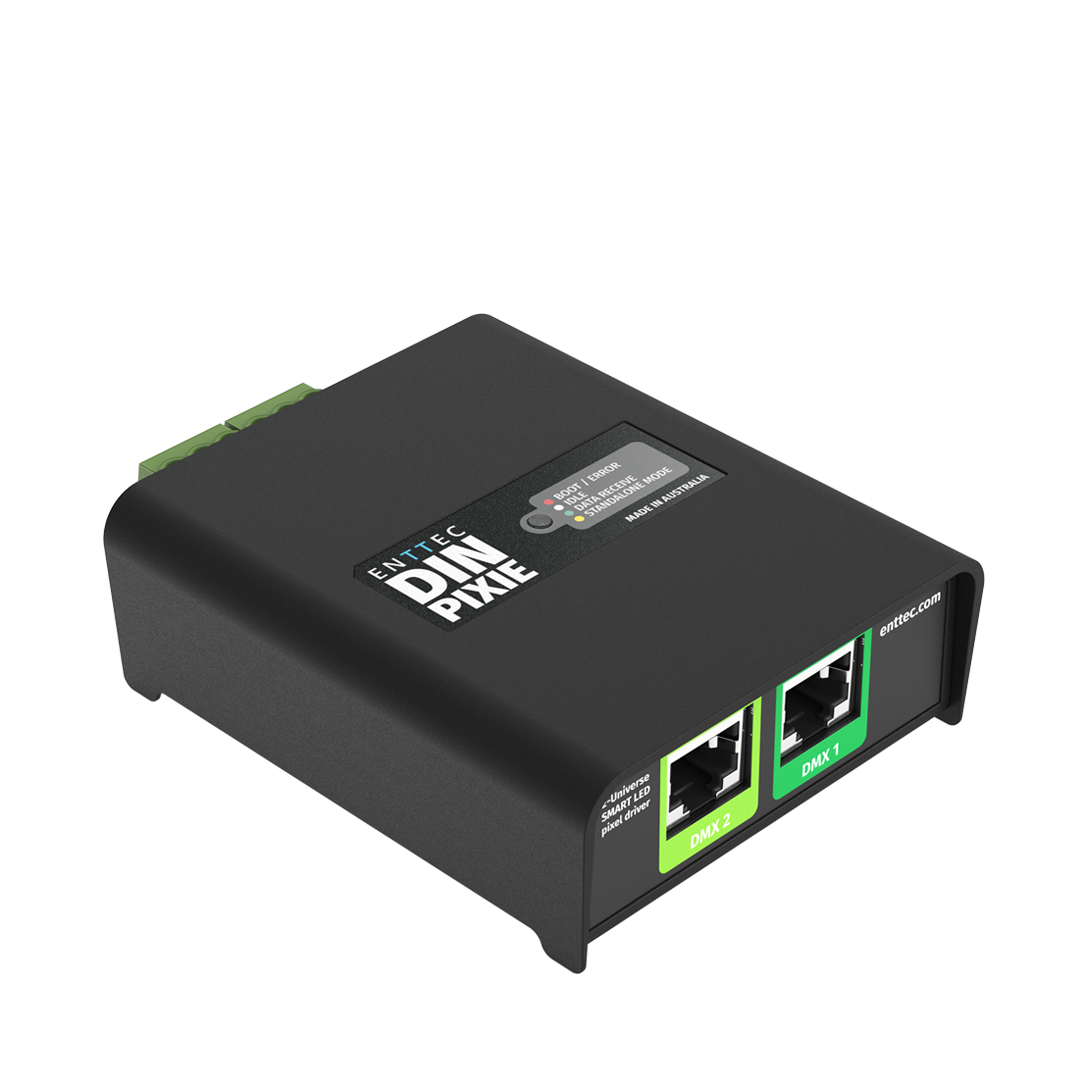
ENTTEC DIN PIXIE

DMX-to-LED-pixel converter and standalone player, about US$89

The DIN PIXIE is a two-universe DMX to LED pixel protocol converter and standalone show player, about US$89. It takes DMX in over two RJ45 ports and outputs SPI over Phoenix connectors, supports more than twenty pixel protocols including WS2812B, WS2811, SK6812, APA104, GS8208B and UCS2903, refreshes at up to 40 fps under live DMX, and can store and play back up to four universes on its own. It powers from the LED supply at 5 to 48 V. It is the piece that lets an addressable ring array behave like an ordinary DMX fixture in a lighting desk or QLC+ show.

Image: enttec.com

Productactive

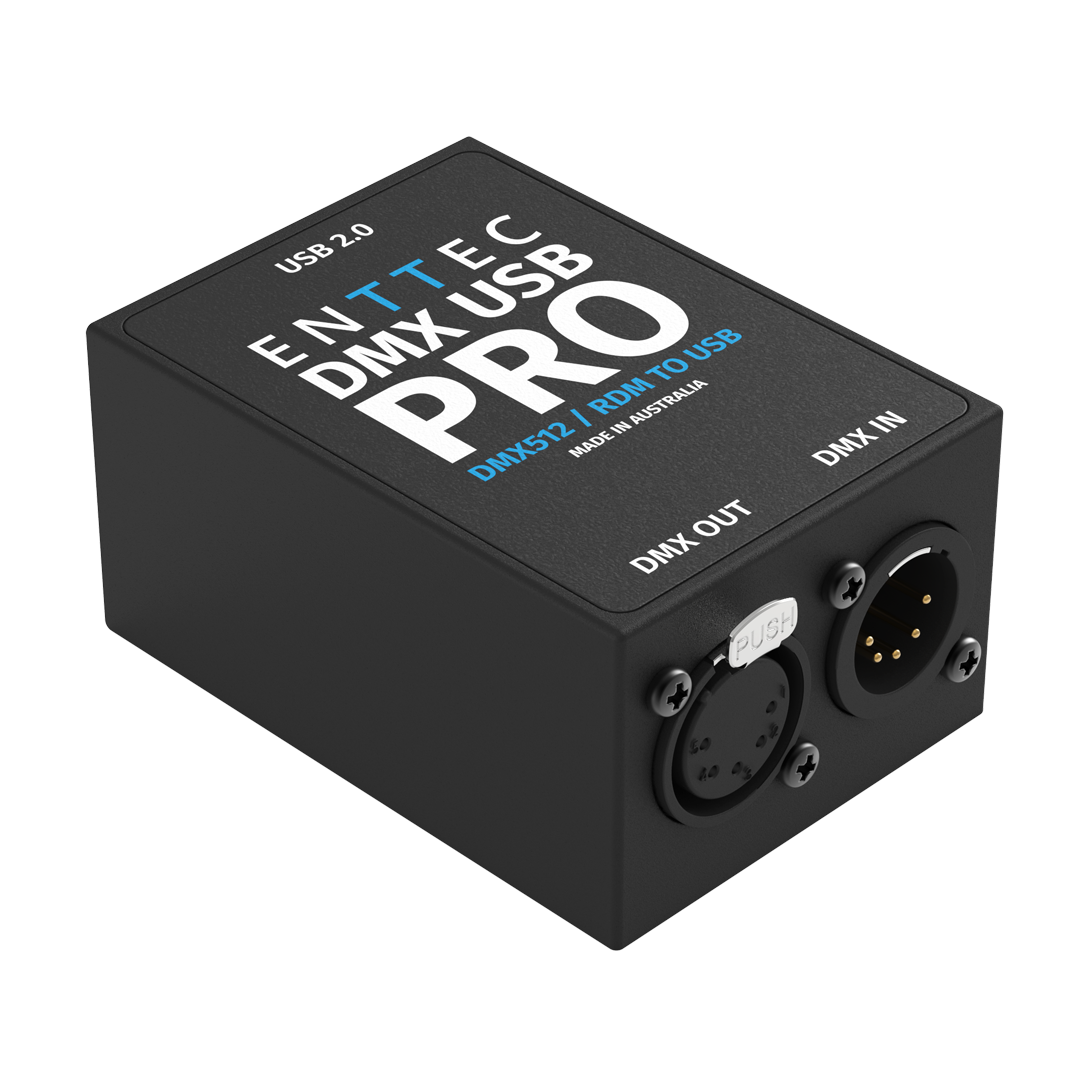
ENTTEC DMX USB PRO

Isolated, buffered USB-to-DMX interface with RDM

The DMX USB PRO is the interface most lighting software assumes: 512 channels, five-pin XLR, USB 2.0 type-B, 1500 V isolation on data and power, and an internal frame buffer so DMX output stays steady regardless of what the host CPU is doing. It works on Windows, macOS, Linux and Raspberry Pi, does DMX input as well as output, supports RDM, and has an adjustable 1 to 40 fps refresh rate with configurable break and mark-after-break timing. No price is shown on the page. The adjustable refresh rate is the detail worth noting when strobing lights against an audio frequency.

Image: enttec.com

Productactive

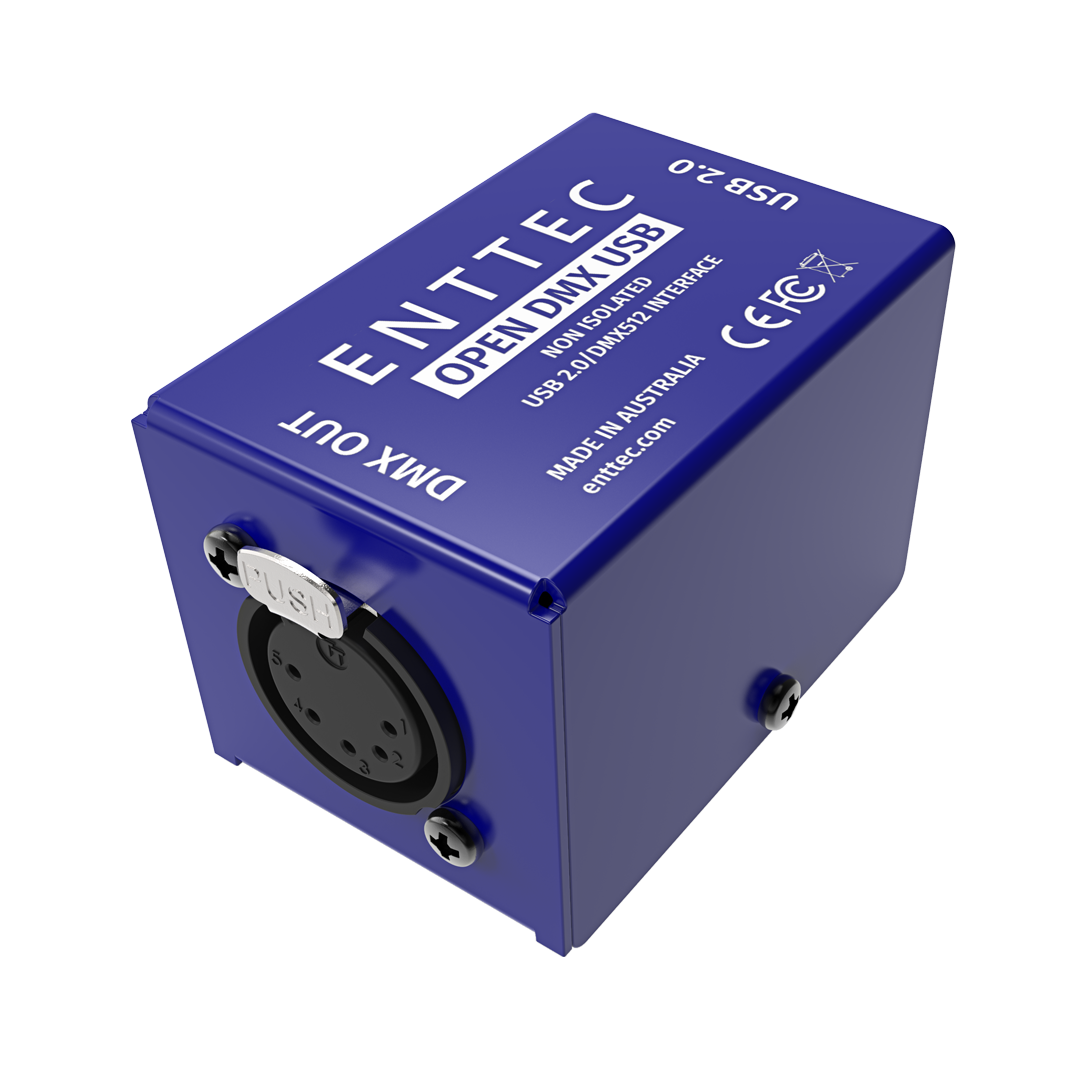
ENTTEC Open DMX USB

Cheapest USB-to-DMX output interface, about US$70

Open DMX USB is ENTTEC's minimal computer-to-DMX interface, about US$70: a USB type-B port in, a five-pin DMX out, 512 channels, folded metal construction, and FTDI drivers for Windows, macOS and Linux. ENTTEC itself calls it a no-frills, inexpensive way into DMX control and recommends it for project work, small live music and amateur theatre. It has no isolation and no internal frame buffer, so timing depends on the host computer — acceptable for a bench rig, less so for a long installation.

Image: enttec.com

ProductactiveMinnesota, USA

Extreme Bubbles beeboo Big Bubble Mix

Big-bubble solution from a Guinness record holder, from about US$11

Extreme Bubbles, based in Minnesota, sells big-bubble solution, wands and kits and states that its beeboo mix was used to set a Guinness World Record. The mix starts at about US$11; a refill pack of four bottles with a two-gallon mixing pail is about US$50, and a ready-mixed small-bubble solution is about US$10. Products are made in the USA. For thin-film cymatics the point of a mix like this is film longevity and thickness stability: interference colours only read on camera if the film survives long enough to be driven and filmed.

Image: Extreme Bubbles

Productactive

Fosi Audio BT20A Pro

TPA3255 class-D stereo amplifier, about US$100

A compact class-D stereo power amplifier built on the Texas Instruments TPA3255, about US$100, with Bluetooth 5.0 and RCA inputs and a pre-out alongside the speaker terminals. Fosi quotes 300 W per channel into 4 ohms, THD of 0.005 percent or less and signal-to-noise of 108 dB or better. Amplifiers of this class are the usual middle link in a cymatics chain: a signal generator or laptop feeds the RCA input, and the speaker terminals drive an exciter, shaker or bare woofer with far more headroom than a lab generator's own output.

Image: fosiaudio.com

Productactive

Max/MSP

Visual patching environment for audio, video and hardware

Max, made by Cycling '74, is a visual programming environment in which objects are connected by patchcords to build interactive software. It covers audio synthesis and processing, real-time video and graphics through Jitter, sensor and hardware integration, and code generation via Gen, and it extends through a package manager and through C++, Node.js, Java or JavaScript. The site offers a 30-day fully unlocked trial but does not state prices on that page. For cymatics it is a common way to script frequency sweeps, hold precise tones and synchronise them with camera triggers or lighting cues.

Image: cycling74.com

Productactive

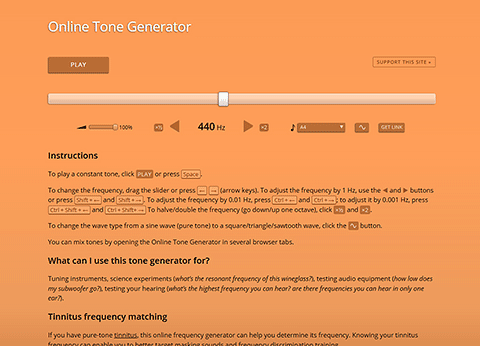
Online Tone Generator (Szynalski)

Free browser tone generator with fine frequency control

A free browser-based tone generator built by Tomasz P. Szynalski. It plays a continuous tone controlled by slider, arrow keys or precise increment buttons, switches between sine, square, triangle and sawtooth, has octave halve and double buttons, and can be layered by opening several tabs. The page carries a sensible warning about setting a comfortable level at 1000 Hz before exploring extremes, since high levels at unusual frequencies can damage hearing or speakers. It is the quickest zero-cost way to sweep a plate or vessel by hand and note where patterns form.

Image: Tomasz P. Szynalski

Productactive

PASCO Chladni Plates Kit (WA-9607)

Square and circular 24 cm lab Chladni plates with sand and shaker

PASCO's WA-9607 is a teaching-lab Chladni set: one square plate with 24 cm sides, one circular plate of 24 cm diameter, 1 kg of extra-fine sand and a sand shaker. Sand collects on the nodal lines when the plate is driven at a resonance, showing the vibration modes directly. The kit does not vibrate anything by itself and lists the WA-9855 Wave Driver as a required accessory. PASCO does not publish a price; the site asks buyers to add to cart for a quotation. The sand is crystalline silica and carries a Proposition 65 warning.

Image: pasco.com

Productactive

PASCO Function Generator (PI-8127)

Lab function generator with ±10 V at 1 A, DC to 100 kHz

The PI-8127 is PASCO's current teaching-lab function generator, replacing the older PI-9587C. It covers DC to 100 kHz with 0.001 Hz resolution across the whole range, holds sine waveform shape to about 150 kHz, and outputs sine, square, triangle and ramp. The important number for cymatics is the drive: ±10 V at 1 A maximum, enough to push a speaker or wave driver directly without a separate amplifier. It also has sweep, ±10 V offset and USB control from PASCO Capstone. Price is quotation-only.

Image: pasco.com

Productactive

PASCO Wave Driver (WA-9855)

Voice-coil mechanical driver for Chladni plates, strings and springs

The WA-9855 Wave Driver is a voice-coil oscillator that converts an electrical signal into mechanical vibration, and it is the part that actually shakes a PASCO Chladni plate. Its page lists uses including standing waves in strings, driving Chladni plates, resonance in metal strips and longitudinal waves in springs. It needs an external function generator supplying at least 8 V at 0.5 A, draws up to 1.2 A AC, weighs 1.8 kg and measures 16 by 11 by 12 cm. PASCO does not publish a price. For a maker it is a rugged alternative to gluing an audio exciter to a plate.

Image: pasco.com

Productactive

Pixelblaze Expansion Boards

Sensor board and output expanders for Pixelblaze, US$19–US$65

ElectroMage sells three expansion boards for Pixelblaze. The Sensor Expansion Board is about US$29 and adds sensor input, which the shop describes as what makes sound-reactive projects straightforward. The Output Expander, about US$19, converts serial to eight WS2812 or APA102 channels; the Pro Output Expander, about US$65, does the same at higher specification. For a studio building several LED rings around one vessel, the expanders remove the wiring bottleneck of a single data pin, and the sensor board is the shortest path from an audio input to light that reacts in time with the drive signal.

Image: ElectroMage

Productactive

Pixelblaze V3 Standard

Wi-Fi LED controller with live-coded patterns, about US$39

Pixelblaze is a Wi-Fi addressable-LED controller with a browser-based editor: patterns are written in a JavaScript-like language and update live over Wi-Fi without recompiling. It is about US$39, supports APA102, SK9822, DotStar, WS2811, WS2812/b, WS2813, WS2815, SK6812 and WS2801, and drives up to 5000 APA102 or 2500 WS2812 pixels on one output, rendering around 48,000 pixels per second and storing up to 100 patterns. Its 3D pixel mapping is directly useful for ring and dome arrays around a cymatics vessel, where the light needs to follow the geometry rather than the wiring order.

Image: shop.electromage.com

Productactive

QLC+ (Q Light Controller Plus)

Free cross-platform lighting control software, Apache 2.0

QLC+ describes itself as free, cross-platform software to control DMX or analogue lighting systems such as moving heads, dimmers and scanners, for live shows, theatre, architectural installations and venues. It runs on Linux, Windows 10 or later, macOS 10.12 or later and Raspberry Pi, and speaks MIDI, OSC, HID, DMX, Art-Net, E1.31/sACN and OS2L. It is licensed Apache 2.0 and maintained by Massimo Callegari as a fork of Heikki Junnila's original Q Light Controller. For a cymatics studio it is the free way to cue LED rings, strobes and stage lights from one show file.

Image: QLC+ project (qlcplus.org)

Productactive

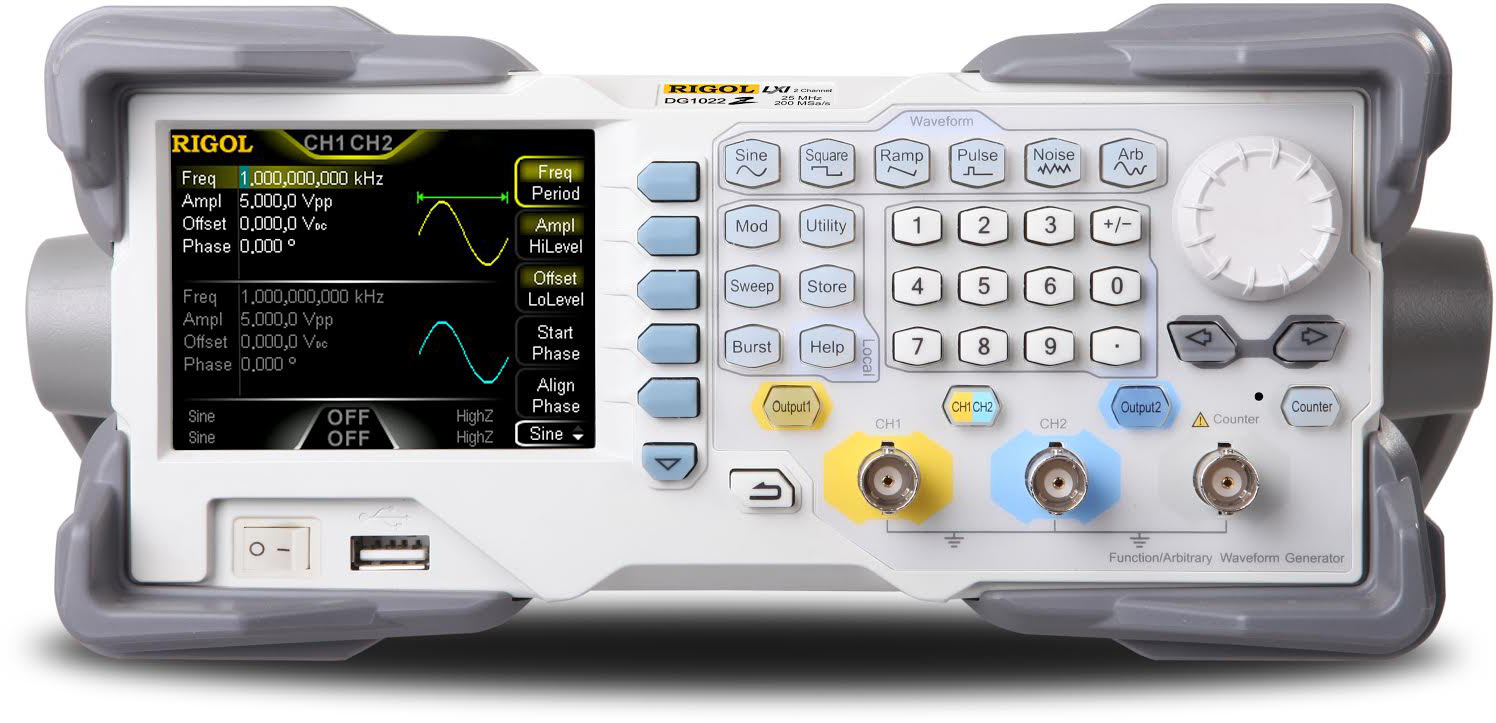
Rigol DG1000Z Series

Two-channel waveform generators from about US$389

Rigol's DG1000Z line is a common budget bench generator: two channels, up to 200 MSa/s and 14-bit resolution, 160 built-in waveforms, AM/FM/PM and digital modulation, sweep, burst and a built-in frequency counter. The published prices are about US$389 for the DG1022Z (25 MHz), about US$449 for the DG1032Z (30 MHz) and about US$529 for the DG1062Z (60 MHz), with a 16 Mpts memory upgrade at about US$180. For cymatics the useful features are the second channel and the sweep function, which lets you crawl through a plate's resonances and note where patterns lock in.

Image: Rigol Technologies

Productactive

Siglent SDG1032X Plus

Two-channel 30 MHz arbitrary waveform generator, about US$493

The SDG1032X Plus is a bench arbitrary waveform generator, about US$493, with two channels, a maximum output frequency of 30 MHz, a 1 GSa/s sample rate, 16-bit vertical resolution, up to 8 Mpts of arbitrary waveform memory per channel and 20 Vpp maximum amplitude. It supersedes the discontinued SDG1032X. Nearly all of that bandwidth is irrelevant to cymatics, which lives below a few kilohertz; what earns it a place is stable, repeatable low-frequency output on two independent channels, which lets you drive a plate on one channel and trigger or phase a strobe from the other.

Image: siglentna.com

Productactive

Sonic Pi

Free code-based music creation and performance tool

Sonic Pi is a free live-coding music environment created by Sam Aaron and the Sonic Pi core team, available for Windows, macOS and Linux, with version 5.0.0 listed as current. Music is written as code and can be changed while it plays. The project stresses that it is free for everyone, usable by professional musicians and DJs, accessible to blind and partially sighted users, and simple enough for school computing and music lessons. For cymatics it is a cheap, scriptable tone source: a few lines will sweep a frequency range or hold a precise tone indefinitely.

Image: Sonic Pi v3.2.0 GUI screenshot, Wikimedia Commons (CC0)

Product5.2.1 released 2025London, United Kingdom

Sonic Visualiser

Free open-source software for close analysis of audio recordings

Sonic Visualiser is a free, open-source application for Windows, Linux and macOS for the visualisation, analysis and annotation of music audio recordings, aimed at researchers, musicologists, archivists and signal-processing specialists. It was initiated and developed at the Centre for Digital Music, Queen Mary University of London, with funding from bodies including EPSRC and the European Commission; version 5.2.1 was released on 21 March 2025. It belongs to a family that also includes Sonic Lineup, Tony and Sonic Annotator. In cymatics it is the tool for finding out what frequencies are actually present in a recording before trying to reproduce them.

Image: Sonic Visualiser project (Chris Cannam, Centre for Digital Music, Queen Mary University of London)

Productactive

Tone Generator: Audio Sound Hz (TMSOFT)

Free iOS tone generator, 20 Hz to 22 kHz

A free iOS and iPadOS app from TMSOFT that generates pure sine tones from 20 Hz to 22,000 Hz. Frequency can be set by slider, by increment buttons or typed in with decimal precision, and changed in real time without restarting playback; it also has presets, a sleep timer, balance and pitch controls, AirPlay output and a setting to play alongside other apps. It requires iOS 14 or later and runs on Apple Silicon Macs. For fieldwork it means the phone in your pocket is a usable drive source when fed into an amplifier.

Image: App Store screenshot, TMSOFT

Productactive

Tone.js

Web Audio framework for interactive music in the browser

Tone.js is a JavaScript framework built on the Web Audio API for making interactive music in a browser. It provides a global transport for scheduling and synchronising events, prebuilt synthesisers and effects, samplers, MIDI support via JSON conversion, and audio-rate signal control for automating parameters precisely. It installs through npm or as a hosted script. The licence is not stated on the documentation home page. For a cymatics studio it is the fastest route to a custom in-browser tone generator or a public-facing web page where visitors drive a rig's frequencies themselves.

ProductactiveCanada

TouchDesigner

Node-based real-time visual programming environment

TouchDesigner, made by the Canadian company Derivative, is a node-based visual programming environment for interactive media: live performance visuals, projection mapping, installations and real-time graphics. It handles high-performance video playback, audio processing with VST plugin support, 3D graphics and a wide range of devices and protocols. Its licensing tiers are not stated on the homepage. In cymatics it is the usual tool for chaining audio analysis to light and camera control in one patch, or for driving generative visuals from the same signal that is driving the plate.

Image: TouchDesigner network editor, Derivative documentation wiki

ProductactiveUnited Kingdom

Water Wonders Kit

Converts a CymaPlate E rig to water imaging, about £944

The Water Wonders Kit is an add-on that moves a CymaPlate E or E+ setup from sand and glitter to water imaging. It costs about £944 and includes a fused quartz cuvette with a black fused quartz bottom, a water container and pipette, a boom stand with a light-ring adapter, a levelling platform, a light ring and power supply, silicone fixing grease and cleaning supplies. The supplied medium-frequency cuvette is specified for 40 Hz to 300 Hz. It is directly relevant to any studio building lit water vessels, since it shows one commercial answer to cuvette geometry and ring lighting.

Image: soundmadevisible.com

Productactive

WLED

Free open-source ESP32 firmware for addressable LEDs

WLED is open-source firmware described by its own documentation as a fast, feature-rich ESP32 webserver for controlling NeoPixel (WS2812B, WS2811, SK6812) and similar LEDs, with a web interface, over 100 effects, 50 palettes, segments and up to 250 presets. It runs on ESP8266 and ESP32 boards, driving up to three outputs on the former and ten on the latter, and supports MQTT and E1.31. It is licensed EUPL-1.2 and led by Christian Schwinne. Its E1.31 support is the practical hook for cymatics: the same lighting desk or QLC+ show that runs DMX fixtures can also drive the LED rings.

Image: WLED project documentation

Technologies 39

Technology2016–presentMIT, Cambridge, Massachusetts

40 Hz gamma sensory stimulation

Light and sound flickering at 40 Hz as an experimental Alzheimer's therapy.

Gamma entrainment using sensory stimulation (GENUS) exposes a person to light flicker, sound clicks or tactile vibration at 40 Hz to drive gamma-band brain rhythms. In 2016 Li-Huei Tsai's group at MIT reported that this reduced amyloid load in mouse models; a 2024 MIT study traced part of the effect to peptide release and glymphatic fluid flow, again in mice. Small human trials report slowed atrophy and modest cognitive benefit, and a 670-person pivotal trial of Cognito's Spectris headset is due to report in 2026. It is promising but unproven in people, and it is not cymatics; it is listed here because 40 Hz claims often circulate alongside cymatics content.

Image: news.mit.edu

Technology1866–present

Acoustic levitation

Holding objects in mid-air with the radiation pressure of sound.

Acoustic levitation suspends small objects against gravity using the radiation pressure of intense, usually ultrasonic, sound. Kundt's tube experiments of 1866 showed the possibility; Bücks and Müller levitated alcohol droplets in 1933; and from the 1970s the Langevin horn with a tuned reflector was the standard design, trapping particles at the nodes of a standing wave. Since 2017 multi-transducer arrays such as TinyLev have made it cheap and reproducible. It is the three-dimensional counterpart of the sand-on-a-plate node: matter gathered where the sound field is quiet.

Image: Argonne National Laboratory, public domain, via Wikimedia Commons

Technology2000s–present

Arduino and DMX lighting control

Driving stage lights, strobes and LED fixtures from a microcontroller.

DMX512 is the serial protocol used by stage and architectural lighting. Two well-established Arduino libraries transmit it: DmxSimple, written by Peter Knight and maintained by Paul Stoffregen, sets any of 512 channels to a 0–255 value through a simple RS-485 driver circuit or the Tinker.it shield; ArduinoDMX, from Arduino SA, uses the ArduinoRS485 library and RS-485 shields such as the MKR 485. For a cymatics rig this lets strobes, RGB washes and dimmers be phased against the audio signal from the same board that drives the exciter.

Image: JrawX, CC0, via Wikimedia Commons

Technology1787–presentGermany (origin)

Bowed plate

Driving a plate to resonance with a violin bow rather than a speaker

The original way to drive a Chladni plate: a rosined violin or cello bow is drawn across the edge of a sand-covered plate while a finger damps the edge at a chosen point. Where the plate is touched and where it is bowed together select which mode rings, and the sand migrates to the nodal lines of that mode. Chladni demonstrated the method before the Paris Academy in 1808, in front of an audience that included Napoleon, who then endowed a prize for a mathematical explanation. Bowing gives clean single modes without amplifiers, which is why lecture demonstrations still use it.

Image: Unknown author, 1879 (from W. H. Stone's acoustics text), public domain, via Wikimedia Commons

Technology1990s–present

Bubble and thin-film (soap film) cymatics

Sound-driven standing waves on a soap film, seen in interference colour.

A soap film stretched over the end of a tube vibrates with a standing-wave pattern when a resonant frequency is played through the tube. Unlike a solid membrane, a liquid film redistributes its own mass, concentrating at the antinodes, and the vibration drives pairs of counter-rotating vortices in the plane of the film. Thickness variations show as interference colours, so the flow can be seen directly. Physicists have used vibrating soap films as an analogue of wave chaos on billiards. For a studio the attraction is that a film gives a bright, colour-rich response at modest sound levels, at the cost of drainage and short life.

Image: fyfluiddynamics.com

Technology2001-2003

Chladni pattern equations (Paul Bourke)

Closed-form equations and code for generating plate patterns

Paul Bourke's page, written in 2001 and extended in 2003, collects the equations used to compute Chladni patterns directly rather than simulate them. It gives the standard superposition for a centre-constrained square plate, cos(nπx/L)cos(mπy/L) − cos(mπx/L)cos(nπy/L) = 0, a Bessel-function form in polar coordinates for circular plates, and a family of three-dimensional interference surfaces of the form cos(c1x) + cos(c2y) + cos(c3z) = 0. It is the usual reference for anyone writing a generative cymatics sketch.

Image: paulbourke.net

Technology1787–presentWittenberg, Germany (origin)

Chladni plate

A flat plate vibrated so that sand collects along its nodal lines.

A Chladni plate is a thin metal or glass sheet, usually fixed at its centre, that is made to resonate while its surface is dusted with sand or another fine powder. The powder is thrown off the moving regions and gathers along the nodal lines, where the plate is still, so each resonance draws its own figure. Robert Hooke saw the effect on flour-dusted glass in 1680, but Ernst Chladni studied it systematically and published it in 1787. It is the founding instrument of cymatics and the basis of most modern speaker-driven rigs.

Image: Revisorius, CC BY-SA 4.0, via Wikimedia Commons

Technology19th century-present

Chladni's law

A rough formula linking mode counts to frequency on a plate

Chladni's law is an empirical relation for the modal frequencies of flat circular plates, written f = C(m + 2n)^p, where m is the number of diametric nodes, n the number of radial nodes, and C and p depend on the plate. For flat circular plates p is roughly 2. The relation has been extended to cymbals, handbells and church bells, where p ranges from about 1.4 to 2.4, and a single object can show different exponents for different mode families.

Image: Wikipedia — Chladni's law

TechnologyUnited Kingdom

CymaScope

A commercial instrument that images sound on a water membrane

The CymaScope is sold as an instrument for producing an analogue image of sound and vibration on a fluid surface, described on its own site as the first scientific instrument able to do so. The site lists claimed applications across more than fifteen fields, including asteroseismology, botany, neurophysiology and sound therapy. Those application claims are the vendor's own and are not equivalent to independent peer-reviewed validation, so treat the instrument as a well-made imaging rig and the surrounding claims separately.

Image: CymaScope (John Stuart Reid), via Internet Archive

Technology2010s–present

Cymatics visualisation software

Apps and web tools that render sound as Chladni or water-like patterns.

Several programs present sound as cymatic imagery on screen. CymaScope App 2.0 (iOS and Android) maps pitches from 27 to 2217 Hz to stored images described as captured on a physical CymaScope, with microphone, keyboard and music input; its marketing frames the imagery in terms of frequency healing, a claim the evidence does not support. CymaVis is a browser tool that runs a particle-based Chladni plate simulator and a 3D water surface from live or uploaded audio. Such tools are lookups or simulations, not measurements: they show what a plate or dish might do, not what one is doing.

Image: cymascope.com

Technology1986-presentUnited States (origin)

DMX512

The lighting control protocol used to drive rigs from a console

DMX512 is the standard digital protocol for stage lighting control. It runs over EIA-485 differential signalling at 250 kbit/s, carrying 512 channels per universe with values from 0 to 255; a full packet takes about 23 ms, giving roughly a 44 Hz refresh rate. It was created by USITT in 1986 and revised in 1990, and is now the ANSI standard E1.11 - 2008. That 44 Hz ceiling matters for cymatics: it is too slow to phase lighting tightly against audio-rate vibration.

Image: Morn, CC BY-SA 4.0, via Wikimedia Commons

Technology2005–presentParis (origin)

Droplets on a vibrating bath (walking droplets)

Bouncing oil droplets that 'walk' on their own waves.

If a bath of silicone oil is vibrated just below the Faraday threshold, a droplet placed on it bounces indefinitely on a thin air layer instead of merging. Above a second threshold the droplet starts to move, pushed by the waves its own impacts leave behind. Yves Couder's laboratory in Paris studied these walkers systematically from 2005 and reported droplet analogues of diffraction, tunnelling and quantised orbits, though attempts in 2015 to reproduce the double-slit interference result failed. For cymatics work the point is practical: a speaker-driven bath near threshold is a controllable droplet playground.

Image: A7N8X, CC BY-SA 4.0, via Wikimedia Commons - "Drop of water dancing on a water surface subject to vibrations"

Technology1885–1904Wales / London

Eidophone

Margaret Watts Hughes's 1880s membrane instrument for 'voice figures'.

The eidophone was a receiver with a flexible rubber membrane stretched over its mouth; the user sang into it and the membrane's vibration shaped sand, powder or coloured glycerine on top into what its inventor called voice figures. The Welsh singer Margaret (Megan) Watts Hughes discovered the effect in 1885, described it in a Century Magazine article in 1891 and published a book on it in 1904. It matters to cymatics as the earliest documented voice-driven membrane instrument, predating Jenny's tonoscope by more than half a century.

Image: Margaret Watts Hughes, "Visible Sound - Voice-Figures", Century Magazine 42 (1891), public domain, via Wikimedia Commons

Technology1831–presentLondon (origin)

Faraday waves

Standing waves on a liquid surface driven by vertical vibration.

When a container of liquid is shaken vertically above a threshold amplitude, its flat surface becomes unstable and breaks into standing waves that oscillate at half the driving frequency, a form of parametric resonance. Michael Faraday described them in 1831; depending on fluid and forcing they form stripes, squares, hexagons or quasi-periodic patterns. Almost all water and thin-film cymatics, including dishes on speakers and the CymaScope, is Faraday-wave physics, and the field of pattern formation has studied it in detail since the 1990s.

Image: Bremps, "Faraday Waves observed in water vibrating at about 50 Hz", via Wikimedia Commons (full 1406x818 original)

Technology1963–present

Ferrofluid displays

Magnetic liquid shaped by electromagnets, often driven by music.

Ferrofluid is a suspension of magnetic nanoparticles in oil, developed by Steve Papell for NASA in 1963 as a fuel that could be pulled by a magnetic field in weightlessness. Under a strong vertical field its surface breaks into the spiked Rosensweig instability. Audio-reactive displays drive electromagnets from the music signal so the fluid leaps and spikes in time with it, and artists such as Sachiko Kodama have built sculptures around it. It is related to cymatics rather than part of it: the shaping force is magnetic, not acoustic, even when the signal is sound.

Image: Wikipedia — Ferrofluid

Technology2013

Frame-rate aliasing water trick (24 Hz / 24 fps)

A hose on a subwoofer at 24 Hz looks frozen to a 24 fps camera.

A widely shared 2013 demonstration ran a hose over a subwoofer playing a 24 Hz sine wave while filming at 24 frames per second. Because each frame catches the vibrating hose at the same phase, the falling water appears to hang in mid-air as a standing sinusoid; a small detuning makes it seem to crawl backwards. Hackaday's write-up stresses that the effect is a camera artefact, the same aliasing as a strobe, and that to the naked eye it is only splashing water. It is a useful cautionary example for anyone filming cymatics.

Image: hackaday.com

Technology1840s–presentGlasgow, Scotland (origin)

Harmonograph

Pendulum-driven drawing machine that traces Lissajous-like figures.

A harmonograph uses two or more pendulums to move a pen and a drawing surface at right angles, so their decaying oscillations trace ellipses, spirals and Lissajous curves. The devices appeared in the mid-nineteenth century, are usually credited to the Glasgow mathematician Hugh Blackburn, and were a popular parlour amusement in the 1890s. It matters to cymatics as a purely mechanical way of drawing the same superposed oscillations that a laser or a plate makes visible, and harmonograph drawings are often shown alongside Chladni figures.

Image: Wikipedia — Harmonograph

Technology20th century–present

High-speed filming of vibrating surfaces

Cameras above 250 frames per second to resolve waves and droplets.

A high-speed camera captures moving images with exposures shorter than a thousandth of a second or at more than 250 frames per second; modern digital systems run from a few thousand to millions of frames per second, and continuous recording with post-triggering removes the need to time an event exactly. For cymatics it is the alternative to a strobe: rather than sampling one phase of the motion, it records the whole cycle of a Faraday wave, a bouncing droplet or sand leaving an antinode. Consumer phones now offer several hundred frames per second, enough for low-frequency water work.

Image: Nathan Boor / Aimed Research, CC BY-SA 3.0 via Wikimedia Commons — Phantom v12.1 high-speed camera by Vision Research

Technology1866–presentGermany (origin)

Kundt's tube

Powder in a glass tube piles up at the nodes of a standing sound wave.

Kundt's tube is a transparent horizontal pipe with a sound source at one end and a movable piston at the other, lightly dusted inside with cork dust, talc or lycopodium powder. At resonance the powder settles into heaps at the nodes, spaced half a wavelength apart, so the speed of sound can be worked out from the frequency. August Kundt built it in 1866 to measure sound speed in gases and solids. It is the one-dimensional relative of the Chladni plate and one of the earliest demonstrations that sound can be made to arrange matter.

Image: Wikipedia — Kundt's tube

Technology1970s–present

Laser cymatics (laser on mirror on speaker)

A laser bounced off a mirror glued to a vibrating membrane.

A small mirror is fixed to a membrane (a balloon or cling film stretched over a bowl with a speaker inside) or directly to a speaker cone, and a laser pointer is aimed at it so the reflection lands on a wall. Each ripple reaching the mirror tilts it slightly, and the spot traces looping figures that change with pitch and timbre. Hackaday's 2024 write-up notes the technique dates back to when helium-neon lasers became affordable. It needs no electronics beyond a speaker, but laser power and beam direction must be handled safely.

Image: Amanda.yuu, CC BY 4.0, via Wikimedia Commons — red and green lasers reflected off a mirror on a vibrating membrane over a speaker

Technology

Laser lighting display

Galvanometer-scanned beams drawing audio-driven figures

Laser displays steer a narrow coherent beam with galvanometer scanners, one for each axis, so a pair of drive voltages positions the spot anywhere on a surface. Feeding two audio signals to the two axes produces Lissajous figures, which is the same principle as gluing a mirror to a loudspeaker and bouncing a laser off it. Beams are bright enough to injure eyes and are regulated; professional practice uses beam stops and keeps beams above audience head height.

Image: Wikipedia — Laser lighting display

Technology1815-present

Lissajous figures

Two perpendicular oscillations drawn as a curve, by pendulum, scope or laser.

A Lissajous curve is the path traced when a point is driven by two perpendicular sinusoidal oscillations of different frequency; Nathaniel Bowditch studied them in 1815 and Jules Antoine Lissajous in 1857. On an oscilloscope in X-Y mode they show the phase relationship between two signals, and laser lighting displays draw them with two galvanometer-mounted mirrors deflecting a beam. Laser shows synchronised to music emerged in the late 1960s and early 1970s. They are the electronic cousin of the harmonograph and of laser-on-speaker cymatics.

Image: Wikipedia — Lissajous curve

Technology2013–present

NeoPixel ring arrays

Addressable RGB LED rings driven from a single microcontroller pin.

NeoPixels are RGB or RGBW LEDs with the driver chip inside each package, chained so that one data pin controls any number of them. Adafruit sells them as rings of 12, 16, 24 and 60 pixels (the 60 as four quarter arcs to be soldered together), about 3.6 mm thick, with RGBW versions available in cool, neutral and warm white. Their guide warns about solder bridges on the tightly spaced pads and about data degradation on leads longer than about a metre. Concentric rings around a dish give even, programmable, colour-changing illumination for water and film cymatics.

Image: Adafruit Industries, NeoPixel Uberguide

Technology2000s–present

Oobleck on a speaker

Cornflour and water that stiffens into fingers under bass.

Oobleck is a mixture of roughly 1.5 to 2 parts cornflour to 1 part water, named after a Dr Seuss book. It is shear-thickening: it flows when stirred slowly but becomes stiff when struck. Placed on a large subwoofer driven hard at low frequency, it thickens and forms standing waves and finger-like protrusions that rise and fall with the signal. It is a cheap, non-toxic way to show how a fluid's response to vibration depends on its rheology, and a staple of cymatics videos.

Image: Wikimedia Commons

Technology19th century-present

Parametric forcing and subharmonic response

Why a shaken dish answers at half the frequency you drive it at

Parametric excitation means modulating a property of an oscillator rather than pushing it directly, and it is what makes a vertically shaken fluid go unstable. The small-amplitude case is described by the Mathieu equation, and resonance occurs when the drive is about twice a natural frequency, so the response appears at half the drive. This is the reason a dish of water driven at 60 Hz shows a pattern flipping at 30 Hz, which matters when phasing a strobe or a camera against the sound.

Image: Bremps, CC BY-SA 4.0, via Wikimedia Commons

Technology1808–present

Plate vibration theory (Kirchhoff–Love, Chladni's law)

The mathematics behind Chladni figures: biharmonic modes and Bessel functions.

The free vibration of a thin plate is described by Kirchhoff–Love theory, formulated by A. E. H. Love in 1888 on Gustav Kirchhoff's assumptions, which reduces the problem to a fourth-order biharmonic eigenvalue equation. Circular plates give Bessel-function modes; rectangular plates give sine-product modes indexed by two integers. Chladni's law, f = C(m + 2n)^p, estimates the frequency of a centre-fixed circular plate's mode with m diametric and n radial nodes, with p about 2 for flat plates. This is the theory that Napoleon's 1808 prize asked for and that Sophie Germain and Kirchhoff supplied.

Image: Wikipedia — Vibration of plates

Technology20th century–present

Ripple tank

A shallow water tray with a vibrating bar for projecting wave behaviour.

A ripple tank is a shallow glass tray of water lit from above or below so that the shadows of surface ripples fall on a screen. A bar or point dipper on elastic bands, shaken by an off-centre motor, makes plane or circular waves, and a strobe can freeze them. It demonstrates reflection, refraction over a submerged glass plate, diffraction through gaps and two-source interference. For cymatics it is the classroom apparatus that shows, in plain water, the interference that produces nodal patterns on plates and dishes.

Image: Wikipedia — Ripple tank

Technology1905-presentGermany (origin)

Rubens tube

A row of gas flames tracing sound pressure along a pipe

A Rubens tube is a perforated pipe sealed at both ends, fed with flammable gas and driven by a loudspeaker at one end. At resonance the standing wave sets up alternating high and low pressure zones along the tube, and the flame heights follow them, rising at the pressure antinodes. Heinrich Rubens built the original in 1905 from about four metres of pipe with roughly 100 holes of 2 mm. It gives a vivid but hazardous demonstration and needs proper gas-handling precautions.

Image: Wikipedia — Rubens tube

Technology1864–presentGermany (origin)

Schlieren imaging

Optics that make density changes, including sound waves in air, visible.

Schlieren photography images refractive-index variations in a transparent medium: light passing through the test region is refocused, a knife edge cuts off the undeflected rays, and any bending by density gradients shows as light and dark. August Toepler devised it in 1864 to find flaws in optical glass. It reveals shock waves, convection and the standing waves inside an acoustic levitator, and in water it maps ultrasonic beams. For cymatics it is the way to see the sound field itself rather than its effect on a surface.

Image: Wikipedia — Schlieren photography

Technology2000s–present

Speaker-mounted dish (water cymatics)

A shallow dish of liquid driven from below by a loudspeaker or piezo.

The commonest home-built cymatics rig: a dish, cuvette or flat sounder is fixed to a loudspeaker, exciter or piezo disc, filled with a few millimetres of water, and driven from a tone generator or amplifier. Above a threshold the surface shows Faraday waves whose symmetry changes with frequency, depth and vessel shape; lit from the side or above, the ripples act as lenses and are easy to film. RMCybernetics documents a minimal version using a flat piezo sounder on a plastic tube with salt, water or cornflour on top. It is the platform most artists and studios build on.

Image: Wikipedia — Faraday wave

Technology1833–present

Strobe-synchronised viewing

Flashing light at or near the drive frequency to freeze vibration.

A stroboscope makes cyclic motion appear stationary or slowed by illuminating it in brief flashes; when the flash rate matches the vibration frequency the object is seen at the same phase each time. Joseph Plateau and Simon Stampfer introduced disc stroboscopes in 1833, and Harold Edgerton's flash-lamp versions made the technique standard for studying machinery. Detuning the strobe slightly from the drive frequency gives a slow-motion view of a Chladni plate, a water surface or a droplet. Phasing LEDs or strobes against the audio signal is how a cymatics rig shows the wave itself rather than a blur.

Image: Wikipedia — Stroboscope

Technology1960s–presentDornach, Switzerland (origin)

Tonoscope

Hans Jenny's device for making voice and tone visible on a membrane.

A tonoscope is any instrument that makes sound visible by displaying its vibrations; the word was coined by the Swiss physician Hans Jenny, who built the first one. Jenny's tonoscope let a person speak or sing into a tube so that the voice set a membrane vibrating, with quartz sand on the membrane forming a figure of the vowel or tone without any electronic link in between. He also used crystal oscillators and piezo elements to drive plates and membranes across a wide frequency range. The tonoscope is the direct ancestor of speaker-and-membrane cymatics rigs, and the term is still used for them.

Image: Elilopes, CC0, via Wikimedia Commons

Technology2017–presentUniversity of Bristol, UK

Ultrasonic standing-wave levitator (TinyLev)

A 3D-printed, Arduino-driven 40 kHz levitator from Bristol, 2017.

TinyLev is a single-axis acoustic levitator built from two opposed arrays of cheap 40 kHz ultrasonic transducers (the kind used in car parking sensors), a motor-driver board, an Arduino and 3D-printed frames. Published by Adrian Barnes, Bruce Drinkwater and Asier Marzo in Review of Scientific Instruments in 2017, it levitates water drops, silica spheres, insects and small electronic parts, trapping objects up to about 4 mm across and denser than 2.2 g/cm3 on about 10 W. Because it needs no high voltage or resonance tuning, it became the standard maker levitator.

Image: bristol.ac.uk

Technology1998Mexico

Vibrating soap film

Thin-film cymatics: mode shapes read off interference colours

A soap film stretched across a frame and vibrated behaves as a two-dimensional membrane, and because its thickness varies with the mode the pattern shows up directly in the thin-film interference colours. Arcos and colleagues used vibrating soap films as an experimental analogue for quantum billiards, resolving normal modes and the narrow high-amplitude regions called scars along classical periodic orbits, and reported that these remain visible at low frequencies. This is the physics behind bubble and thin-film cymatics rigs.

Image: Arcos et al., arXiv:chao-dyn/9903002, Fig. 6 (via ar5iv)

Technology

Vibrations of a circular membrane

The Bessel-function maths behind drumhead and tonoscope patterns

A circular membrane fixed at its rim obeys the two-dimensional wave equation, and its solutions are Bessel functions in the radial coordinate. Each mode is labelled by two integers: m sets the number of nodal diameters and n the number of nodal circles. That indexing is exactly what you see as straight lines and concentric rings in a tonoscope or on a drumhead sprinkled with sand, and it explains why the available patterns are fixed by the geometry of the vessel rather than by the sound.

Image: Wikipedia — Vibration of a circular membrane

Technology1980s–presentNorway (origin)

Vibroacoustic therapy devices

Beds, chairs and mats that pass low-frequency sine waves into the body.

Vibroacoustic therapy delivers low-frequency sine-wave vibration, usually between 30 and 120 Hz, through transducers or bass shakers built into beds, chairs, mats or wearables. It was developed in Norway by Olav Skille in the 1980s. Proposed mechanisms are vibration sensation and brainwave entrainment. In the United States the devices are regulated as equivalent to therapeutic massagers and are not required to show clinical efficacy; sceptics call the practice pseudoscience, and its own proponents acknowledge that more research is needed. It overlaps with cymatics only in sharing hardware and the vocabulary of frequency.

Image: Kantor et al., Frontiers in Psychology (2022), CC BY 4.0

TechnologyactiveUniversity of New South Wales, Sydney, Australia

Violin plate tuning with Chladni patterns

Luthiers reading nodal patterns on unassembled violin plates

Violin makers use Chladni figures to check the stiffness and symmetry of a top or back plate before assembly. In the University of New South Wales demonstration a small 0.2 g magnet is glued to the plate and driven by an oscillating magnetic field tuned to each resonance, rather than bowed, so individual modes can be isolated and photographed. The page compares hand-made and mass-produced plates across roughly seven modes, including the ring mode.

Image: Joe Wolfe, School of Physics, UNSW Sydney

Technology2011–present

Web Audio API

Browser tone generation and analysis for driving cymatics hardware.

The Web Audio API is a JavaScript interface in which audio nodes are connected into a processing graph inside an AudioContext. An OscillatorNode generates sine, square, sawtooth, triangle or custom waveforms at a set frequency, and an AnalyserNode returns real-time frequency and waveform data for visualisation. A laptop or phone browser can therefore act as a precise, scriptable signal generator for a plate or dish, sweep frequencies, and expose the spectrum to drive LEDs or strobes over serial or a network. Online tone generators used in most DIY cymatics guides are built on it.

Image: developer.mozilla.org

References 19

Reference

Acoustic Levitator (Instructables)

A 27-step build guide for a DIY ultrasonic levitator

Instructables hosts a 27-step illustrated build guide titled "Acoustic Levitator", the widely circulated maker route into ultrasonic standing-wave levitation using arrays of 40 kHz transducers, a 3D-printed frame and a microcontroller driver. It is the practical companion to the TinyLev paper for anyone building a rig rather than reading about one. Note that the page returned only its title to our fetcher, so nothing beyond the title and step count is asserted here.

Image: instructables.com

Reference2013

Advances in the Emergent Science of Cymatics (retracted)

A Reid chapter on cymatics that Crossref records as retracted

J. S. Reid, L. Dennis and P. McNair contributed a chapter titled "Advances in the Emergent Science of Cymatics" to The Mereon Matrix, published by Elsevier in 2013 at pages 287-304. The Crossref record now carries the title prefix "RETRACTED", and no retraction notice or reason is included in the metadata. John Stuart Reid is associated with the CymaScope instrument, and this item is often cited in cymatics writing, so the retraction status is worth knowing before citing it.

Reference1787Leipzig

Chladni 1787: Entdeckungen über die Theorie des Klanges

The 77-page Leipzig quarto that introduced sand figures on vibrating plates.

Ernst Florens Friedrich Chladni's Discoveries in the Theory of Sound was published in Leipzig by Weidmanns Erben und Reich in 1787: 77 pages with eleven engraved plates by Johann Stephan Capieux. It describes bowing sand-covered plates and catalogues the nodal figures obtained, the first systematic account of what are now called Chladni figures. It is in German and in the public domain; the Internet Archive copy can be read or downloaded, and other digitisations exist at e-rara and the Bavarian State Library.

Image: Title page of Chladni's 1787 Entdeckungen über die Theorie des Klanges, Niels Bohr Library & Archives, AIP; public domain, via Wikimedia Commons

Reference1990Paris

Douady 1990: Experimental study of the Faraday instability

Stéphane Douady's foundational measurements of parametrically excited waves.

S. Douady's "Experimental study of the Faraday instability", Journal of Fluid Mechanics volume 221, pages 383-409, 1990, reports measurements of eigenmodes in a closed vessel, stability boundaries, wave amplitude and the decay of perturbations, and matches them to an amplitude equation derived from symmetry. It shows how the meniscus and edge constraints alter dissipation and eigenfrequencies, finds the transitions to be consistently supercritical, and describes visualisation methods for large-aspect-ratio cells. It is the standard citation for why vessel edges change the pattern you get.

Reference1994

Edwards & Fauve 1994: Patterns and quasi-patterns in the Faraday experiment

Two-frequency forcing produces twelvefold quasi-crystalline wave patterns.

W. S. Edwards and S. Fauve, Journal of Fluid Mechanics, volume 278 (1994), pages 123–148. Using a shallow, viscous fluid in a large container and driving it with two sinusoidal frequencies at once, they showed that the pattern selected just above threshold depends on the frequency ratio and the relative amplitudes and phases of the two components. Lines, squares and hexagons appeared, and for some ratios a quasi-pattern with twelvefold symmetry, the fluid analogue of a two-dimensional quasicrystal. It is the paper to read for anyone driving a dish with chords rather than single tones.

Reference1831London

Faraday 1831: On a peculiar class of acoustical figures

The Philosophical Transactions paper that first described Faraday waves.

Michael Faraday's paper On a Peculiar Class of Acoustical Figures; and on Certain Forms Assumed by Groups of Particles upon Vibrating Elastic Surfaces appeared in Philosophical Transactions of the Royal Society of London, volume 121 (1831), pages 299–340. Starting from Chladni's sand figures, Faraday investigated fine powders that gather at antinodes rather than nodes, then water, egg white and oils on vibrating plates, and in an appendix described the crispations now called Faraday waves, noting that they oscillate at half the driving frequency. It is the founding text of liquid cymatics.

Image: Michael Faraday, Philosophical Transactions of the Royal Society 121 (1831), p. 299, public domain, via Wikimedia Commons

Reference2010s

Instructables Chladni plate guides

Community build guides, from a mini plate to a purpose-made wave driver.

Instructables hosts several step-by-step Chladni builds, including Easy Chladni Plate, Visualizing Sound / Mini Chladni Plate and Mechanical Wave Driver for Chladni Plate. The last addresses the usual failing of a bare loudspeaker, which throws material off at low frequencies and has to be uncomfortably loud at high ones, by building a dedicated driver. The pages are photographed six-step guides at hobby level; details of materials vary by author, so read the whole guide before buying parts.

Image: instructables.com

Reference1967–1972; 2001 combined editionBasel and Dornach, Switzerland; Newmarket, New Hampshire (publisher)

Jenny: Cymatics, A Study of Wave Phenomena and Vibration

Hans Jenny's two illustrated volumes, reissued as one book in 2001.

Hans Jenny's Kymatik / Cymatics was published in two volumes, the first in 1967 and the second in 1972, the year he died (some editions date the second volume 1974). Both document, in photographs, how sand, powders, pastes and liquids on plates and membranes respond to tones from his tonoscope and oscillators. MACROmedia of Newmarket, New Hampshire, run by Jeff Volk, combined both volumes into a single 295-page hardback in 2001 (ISBN 9781888138078), with a foreword by Ted Gioia and a primer by John Beaulieu. Jenny's photographs remain the most widely reproduced cymatics images; his broader claims about cosmic periodicity are interpretation, not experimental result.

Image: openlibrary.org

Reference2007–presentLink unchecked

Journal of Cymatics (cymatica.com)

A long-running online magazine reporting cymatics art and science news.

The Journal of Cymatics at cymatica.com is an online publication reporting on the art and science of cymatics; search results describe it as founded in 2007 and edited by Jodina Meehan, with posts including coverage of a 2010 School of Cymatics and of the 2019 Reid cancer-cell paper. It is an enthusiast publication rather than a peer-reviewed journal, and it presents contested healing and origin-of-life claims sympathetically. Useful as a record of the community's activity; check any factual claim against a primary source.

Image: Journal of Cymatics / Cymatica, via the Internet Archive

Reference1996Haverford, Pennsylvania

Kudrolli & Gollub 1996: Patterns and spatiotemporal chaos in forced surface waves

A systematic survey of Faraday-wave patterns at large aspect ratio.

Arshad Kudrolli and Jerry Gollub of Haverford College published Patterns and spatiotemporal chaos in parametrically forced surface waves: a systematic survey at large aspect ratio in Physica D, volume 97 (1996), pages 133–154. Working in a wide, shallow cell, they mapped which primary pattern (stripes, squares or hexagons) a vertically shaken fluid selects as viscosity and forcing change, found ranges where different symmetries coexist, and showed that the route to spatiotemporal chaos depends on the primary pattern. It is the standard reference for what a dish on a speaker will do as amplitude and fluid are varied.

Reference2002 (German); 2006 (English)Germany

Lauterwasser: Water Sound Images

Alexander Lauterwasser's photographs of water surfaces driven by sound.

Water Sound Images: The Creative Music of the Universe is the English edition of Alexander Lauterwasser's Wasser Klang Bilder (2002), published by MACROmedia in 2006–07 as a 176-page hardback with about 240 colour photographs. Lauterwasser, born in Überlingen in 1951, photographs small samples of water excited by sources from pure sine tones to Beethoven, Stockhausen and overtone singing. The images are the best-known modern water-cymatics photographs; the book's comparisons of the patterns with shells, organisms and galaxies are visual analogies rather than demonstrated physical connections.

Image: florisbooks.co.uk

Reference2012

Make: Use a Chladni Plate to Visualize Acoustics

Edwin Wise's build guide using a salvaged speaker magnet and a wound coil.

Edwin Wise's Make: project, first published on 18 December 2012 and updated in 2015, builds a Chladni driver from a salvaged loudspeaker magnet and a hand-wound voice coil on a plastic-cup former, with a roughly 60 cm square metal plate bolted to it through a nylon bolt. Driven by a signal generator and audio amplifier, and dusted with sand, salt, gelatine or lycopodium powder, the plate settles into its standing-wave patterns. A companion Make: Weekend Projects video shows the build. It is one of the more thorough free guides for a large speaker-driven plate.

Image: makezine.com

Reference2015University of Bristol / University of Sussex, UK

Marzo et al. 2015: Holographic acoustic elements

Nature Communications paper on single-sided acoustic tweezers.

Holographic acoustic elements for manipulation of levitated objects, by Asier Marzo, Sue Ann Seah, Bruce Drinkwater, Deepak Sahoo, Benjamin Long and Sriram Subramanian, appeared in Nature Communications, volume 6, article 8661, in 2015. By optimising the phase of each element of an ultrasonic array the authors created twin, vortex and bottle-shaped traps that levitate, move and rotate millimetre particles from one side only, moving them at up to 26 cm/s with 0.05 mm positioning. It made acoustic levitation a general manipulation tool rather than a single node in a standing wave, and led directly to TinyLev.

Image: Marzo et al., Nature Communications 6:8661 (2015), CC BY

Reference2016–presentMIT, Cambridge, Massachusetts

MIT News: 40 Hz stimulation coverage

MIT's own reporting on the Picower Institute's gamma-stimulation studies.

MIT News has followed the Picower Institute's 40 Hz work since 2016. A 7 March 2024 article reports a mouse study led by Mitch Murdock with Li-Huei Tsai and Ed Boyden linking 40 Hz light and sound to peptide release and glymphatic clearance of amyloid. A 14 November 2025 article reports on five volunteers who continued daily stimulation for about two years: three late-onset participants showed slower decline and lower phosphorylated tau, two early-onset participants did not, and the authors call for larger randomised trials. A March 2025 PLOS Biology review by Park and Tsai is also summarised. Read as institutional coverage of preliminary results, not independent assessment.

Image: news.mit.edu

Reference1877–1878England

Rayleigh: The Theory of Sound

Lord Rayleigh's two-volume 1877–78 treatise on vibration and acoustics.

John William Strutt, third Baron Rayleigh, published The Theory of Sound in two volumes with Macmillan in 1877 and 1878, with a revised second edition in 1894–96. The first volume treats the vibration of strings, bars, membranes and plates, including the theory behind Chladni's figures, and the second the propagation of sound in fluids. It is usually taken to mark the start of modern acoustics and is still cited for plate and membrane modes. Both volumes are in the public domain and available on the Internet Archive and Wikimedia Commons.

Image: Biblioteca Europea di Informazione e Cultura (BEIC), via Wikimedia Commons (public domain) - title page, Vol. I, second edition, Macmillan 1894

Reference2019

Reid et al. 2019: CymaScope cancer-cell paper

John Stuart Reid's paper in the journal Water on imaging cell 'sounds'.

Imaging Cancer and Healthy Cell Sounds in Water by Cymascope, Followed by Quantitative Analysis by Planck-Shannon Classifier, by John S. Reid, Beum Jun Park and Sungchul Ji, was published in the journal Water, volume 11, in December 2019 (DOI 10.14294/WATER.2019.6). Raman spectra of cancerous and healthy brain tissue were sonified into audio, played through a voice-coil-driven quartz cuvette of water, filmed at 24 frames per second, and the image histograms fitted to a Planckian distribution. The authors claim the classifier separates the two. The inputs are sonifications, not sounds cells make; Water is a small journal outside mainstream oncology, and the result has not been independently replicated.

Image: waterjournal.org

Reference2023

Thin liquid film in a holographic ultrasonic field (2023)

Time-resolved schlieren imaging of a soap film under ultrasound

Weitao Sun and colleagues, arXiv preprint submitted 5 September 2023, used time-resolved schlieren imaging to watch a soap film placed in a holographic ultrasonic field. They report capillary waves, standing waves and travelling waves in the film, an unexpected branch-flow phenomenon, and interactions between vortex and branch flows. The authors argue that visualising the pressure field this way could help optimise acoustic levitation. It is the most directly useful recent paper for anyone doing bubble or thin-film cymatics with ultrasound.

Referenceactive

Wikipedia: Cymatics

The encyclopaedia's overview of the field, with its history and caveats.

Wikipedia's Cymatics article defines the subject as a subset of modal vibrational phenomena in which the maxima and minima of a vibrating plate, diaphragm or membrane are made visible in a thin coating of particles, paste or liquid. It traces the history from Hooke's flour-on-glass observation of 8 July 1680 through Chladni (1787), Faraday and Hans Jenny, who coined the term and published in 1967 and 1972. The article sits in Wikipedia's pseudoscience category, reflecting the healing and cosmological claims that have attached to the word, while the underlying physics is uncontroversial. A useful first read and a reminder of the term's reputation.

Image: Wikipedia — Cymatics

Referenceactive

Wikipedia: Standing wave

Nodes, antinodes and why patterns stay put on a vibrating surface.

Wikipedia's Standing wave article explains a wave whose amplitude profile does not move in space, arising when two waves travelling in opposite directions interfere, most often through resonance. Nodes are the fixed points of minimum amplitude and antinodes the points of maximum amplitude. The article notes that Faraday first described standing waves scientifically in 1831 on vibrating liquid surfaces and that Franz Melde coined the term around 1860, and it covers strings, Chladni figures on membranes and Kundt's tube. It is the single physics concept every cymatics demonstration depends on.

Image: Wikimedia Commons (File:Standing wave 2.gif)