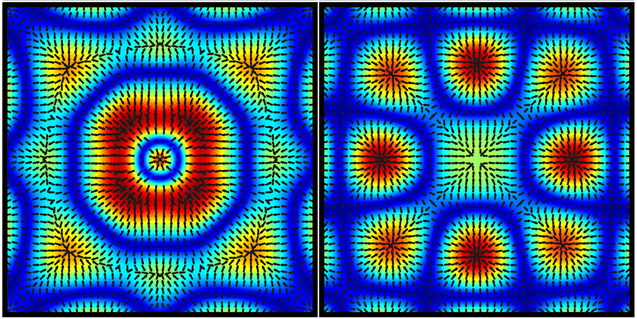
Sam Jarman's report covers work by Kourosh Latifi, Harri Wijaya and Quan Zhou at Aalto, published in Physical Review Letters. Submerge a vibrating plate and 750-micrometre glass beads stop behaving as they would in air: instead of settling on the nodal lines they gather at the antinodes, because fluid drag stops them bouncing clear of the surface.
The team built a statistical model of bead position against driving frequency, then used it for control — guiding single beads through a maze, moving several along complex paths at once, and splitting clusters apart.
This is the short version of a longer literature on inverse Chladni patterns in liquids, and it is the clearest statement of the practical rule: whether your particles run to the nodes or the antinodes depends on the surrounding medium and on particle size, not on the plate alone. Anyone moving a rig from dry sand to a wet dish should expect the pattern to invert.